Best 8 Residential VPN providers in 2026
In 2026, residential VPNs are becoming increasingly popular as a stealthy and reliable solution for online privacy. Unlike traditional VPNs that use datacenter IPs, which can be easily detected and blocked by websites, residential VPNs route your internet traffic through real home IP addresses provided by ISPs. This makes your online activity look like that of an ordinary user, helping you bypass geo-restrictions, avoid CAPTCHAs, and reduce blocks on platforms that monitor VPN traffic.
Residential VPNs are especially useful for streaming, online privacy, account management, and business or marketing applications where detection could cause disruptions. This guide explores the best residential VPN providers in 2026, explains why this category is unique, and helps you choose the right provider based on your needs.
What Is a Residential VPN and Why It Matters
A residential VPN is similar to a traditional VPN in that it encrypts your internet traffic and hides your real IP address, keeping your online activity private and secure. However, it differs in one crucial way: instead of routing your connection through servers in datacenters, a residential VPN uses IP addresses assigned to actual home internet connections. These are genuine ISP-issued addresses, making your traffic appear as if it’s coming from a normal household rather than a commercial server.
This approach makes residential VPN traffic much harder to detect, flag, or block. Traditional VPN IPs are widely recognized and often blacklisted by websites, streaming platforms, and online services that actively prevent VPN usage. In contrast, residential IPs blend seamlessly with everyday internet traffic, making them ideal for stealthy browsing, accessing geo-restricted content, managing multiple accounts, or conducting sensitive online activities where detection could lead to interruptions.
Residential VPNs also provide a more authentic online presence, which is particularly useful for tasks like marketing research, price comparisons, and other professional or commercial use cases that rely on reliable access without the risk of IP blocks or CAPTCHAs. For tasks that require long-term identity retention, such as managing e-commerce storefronts, utilizing a static residential proxy can offer even greater stability. In short, residential VPNs combine the privacy and security of traditional VPNs with the added benefit of appearing like a regular internet user, giving you both protection and credibility online.
Shortlist - Best Residential VPN Providers (Quick Picks)
- • Mysterium VPN – Best overall true residential VPN
- • CometVPN – Best affordable residential IP VPN
- • Bright Data – Best for enterprise-grade IP coverage
- • Oxylabs – Best for large proxy networks
- • Decodo (Smartproxy) – Best budget proxy-oriented option
- • Surfshark (Dedicated IP) – Best traditional VPN with IP control
- • NordVPN (Dedicated IP) – Strong mix of privacy + static IP
- • DIY Home VPN – Best self-hosted residential IP option
Best Residential VPN Tools in 2026
Mysterium VPN
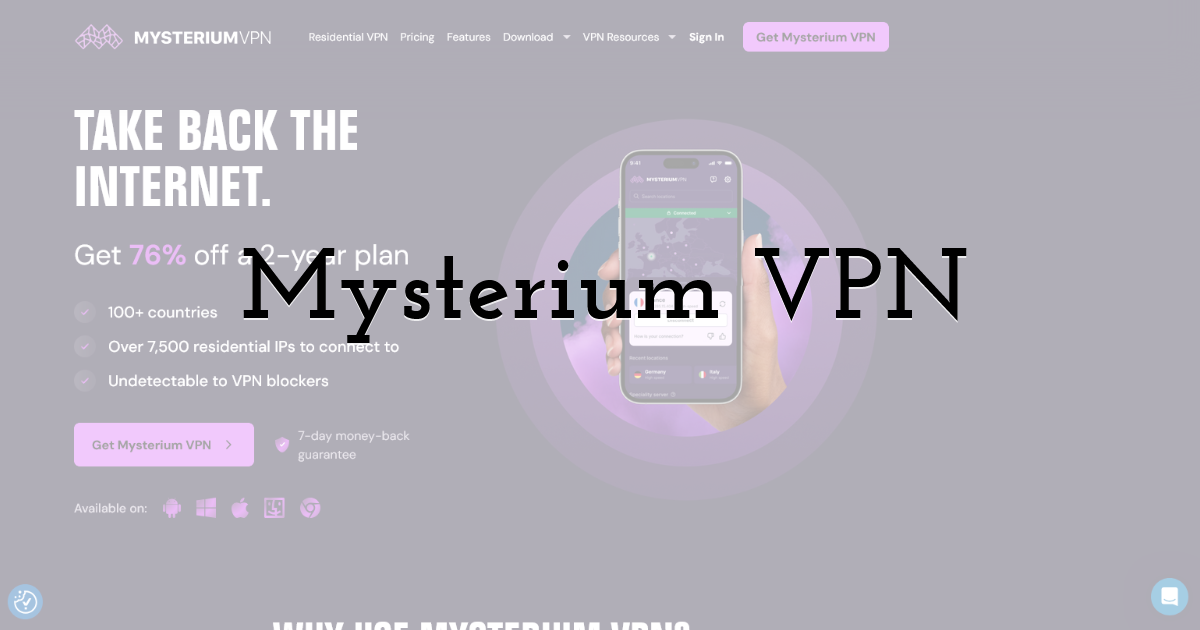
Mysterium VPN is a residential VPN service built on a decentralized network of real residential IP connections rather than central datacenter servers. It uses thousands of ISP‑issued home IP addresses from around the world so that your internet sessions appear like ordinary user traffic, making it much harder for websites and online services to detect that you are using a VPN. This setup helps reduce blocks, CAPTCHAs, and other restrictions that often affect traditional VPN traffic. Mysterium also integrates standard VPN privacy protections including WireGuard encryption, a kill switch, DNS leak protection, and a no‑logs policy to safeguard user privacy and security.
Mysterium VPN emphasizes flexibility, offering its residential IP routing alongside regular fast VPN tunnels in the same application. The service supports connections across over 100 countries with a large pool of residential IP addresses and allows multiple device protection under one subscription.
Pros
- • Uses real residential IPs from a large global network, making VPN usage harder to detect.
- • Designed to help bypass geo‑restrictions and minimize IP blocks.
- • Offers modern encryption protocols, DNS leak protection, kill switch, and a strict no‑logs policy.
Cons
- • Speeds and performance can vary depending on node availability and network conditions.
- • The decentralized model and pricing options may be less familiar to mainstream VPN users.
Pricing: Mysterium VPN offers a 7‑day money‑back guarantee and multiple subscription options: a monthly plan with full features, shorter‑term plans with discounts, and long‑term plans that reduce the monthly cost significantly when billed annually or for two years. Plans can start at approximately a few dollars per month on long‑term subscriptions, with higher monthly pricing for shorter commitments.
CometVPN
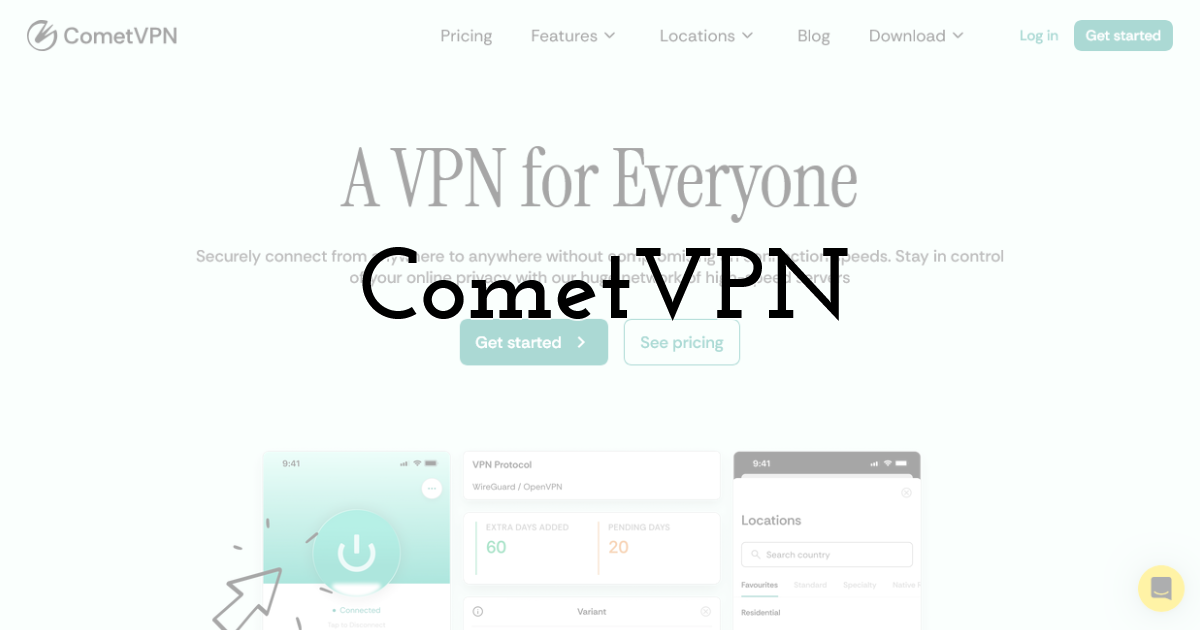
CometVPN is a residential VPN service that prioritizes affordability, flexibility, and ease of use. It gives users access to ISP-issued residential IP addresses, allowing them to bypass geo-restrictions, automated filtering, and blocks on websites and streaming platforms. This makes it a solid option for users who need stealthy online access without paying the premium prices often associated with enterprise-grade residential VPNs.
In addition to its residential IP capabilities, CometVPN also includes standard VPN security features such as WireGuard encryption, DNS leak protection, and a kill switch. This ensures that users enjoy both privacy and protection while browsing, streaming, or conducting sensitive online activities.
CometVPN offers a variety of plans to suit different needs, including rotating residential IPs for maximum anonymity, dedicated IPs for more stable access, and traditional VPN modes for general privacy. Its versatility makes it suitable for casual users, remote workers, and small-scale marketing or research tasks. Community feedback highlights its reliable performance, user-friendly setup, and responsive support, making it an attractive choice for people new to residential VPNs or those seeking an economical alternative.
Pros
- • Budget-friendly pricing that makes residential VPN access accessible
- • Options for both rotating and dedicated residential IPs
- • Strict no-logs policy with fast and modern VPN protocols
Cons
- • Smaller IP pool compared to enterprise-level providers
- • Performance may vary depending on the geographic location and node availability
Pricing: Residential IP plans start from approximately $1.74 per month, while dedicated IP plans start from $2.79 per month, making it one of the more affordable options for residential VPN users.
Bright Data (Proxy-Focused)
Bright Data is one of the largest residential IP networks in the world, providing access to millions of real ISP-issued home IP addresses. While it is primarily marketed as a proxy solution for enterprises, its infrastructure can also serve use cases similar to residential VPNs, including bypassing geo-blocks, avoiding automated detection, and maintaining high anonymity online.
The platform is designed for businesses and professional users who need massive IP coverage, precise geographic targeting, and advanced session management. Its network spans hundreds of countries, making it ideal for tasks that require extensive online access, such as data collection, price comparison monitoring, marketing research, and other commercial applications. Bright Data also provides enterprise-grade tools, APIs, and dashboards that allow users to automate and manage large-scale operations efficiently.
Because Bright Data focuses on enterprise needs, it is highly scalable and reliable, but it is more complex than standard VPN services. Users benefit from full control over IP selection, session duration, and geographic targeting, making it a robust choice for professional or high-volume online activities.
Pros
- • Extremely large global IP coverage, spanning hundreds of countries
- • Enterprise-grade tools, dashboards, and API support for automation
- • Highly reliable for large-scale or professional online operations
Cons
- • Pricing is geared toward enterprises and can be expensive for individual users
- • Steeper learning curve compared to traditional VPNs or simpler residential IP services
Pricing: Bright Data pricing is typically bandwidth-based and tailored for enterprise use, with plans often requiring custom quotes based on the scale of usage.
Oxylabs (Proxy-Focused)

Oxylabs operates one of the largest residential proxy networks in the world, offering access to millions of real ISP-issued home IP addresses. While its services are primarily designed for enterprise and professional use, the platform can also function as a residential IP solution for advanced users who require large-scale access, precise geo-targeting, and customizable sessions.
Oxylabs excels in providing fine-grained control over IP selection and session management, allowing users to select specific locations, maintain long-lived sessions, and rotate IPs according to their workflow. This makes it particularly valuable for tasks such as data collection, web scraping, price monitoring, SEO research, and other professional applications where reliability and scale are critical.
Because Oxylabs is built for enterprise needs, it is powerful but more complex than typical consumer VPN services. It offers tools and dashboards that support automation and large-scale operations, but it may require some technical expertise to set up and manage effectively. For users who need robust IP coverage, precision targeting, and high scalability, Oxylabs is one of the most capable residential IP networks available.
Pros
- • Huge global IP pool covering millions of addresses across many countries
- • Excellent geo-targeting and session control for professional tasks
- • Reliable and scalable for large-scale online operations
Cons
- • Pricing and plans are complex and aimed at enterprise users
- • Not designed as a simple consumer VPN application
Pricing: Oxylabs uses bandwidth-based, enterprise-level plans, typically requiring custom quotes depending on usage volume and geographic requirements.
Decodo (formerly Smartproxy)

Decodo is a residential IP platform that provides a massive global pool of ISP-issued home IP addresses, designed primarily for developers, marketers, and professional proxy users. The service offers an intuitive dashboard and tools that make it easy to manage sessions, monitor usage, and control IP rotation. Users can choose between sticky sessions, which maintain the same IP for longer periods, or rotating sessions, which switch IPs automatically to maximize anonymity and reduce detection.
While Decodo is not a traditional VPN client, it provides functionality similar to residential VPNs for users who need access to broad geographic coverage and flexible IP management. Its platform supports multiple protocols and can be adapted for a variety of tasks, including data collection, account management, online testing, or bypassing geo-blocks. It’s particularly useful for users who require residential IP access without needing full device-wide VPN encryption.
Pros
- • Large global IP pool with support for both sticky and rotating sessions
- • Flexible session options and multiple protocol support
- • Easy-to-use interface suitable for both beginners and professionals
Cons
- • Not a full VPN, so it does not encrypt all traffic from the device
- • More suitable for specific tasks rather than general online privacy
Pricing: Decodo uses proxy bandwidth-based plans, with residential IP pricing typically starting at a few dollars per GB, depending on the plan and usage requirements.
Surfshark (Dedicated IP Option)
Surfshark is a popular VPN provider known for its affordable plans, strong security, and unlimited device support. For users who need a stable and reliable IP, Surfshark offers a dedicated IP add-on, which provides a static address that behaves more predictably than shared datacenter IPs. This is particularly useful for activities such as accessing restricted accounts, managing multiple logins, or minimizing flags from websites that often detect and block shared VPN addresses.
While Surfshark’s dedicated IP is not a true residential IP, it offers many of the same practical benefits, including more consistent connectivity, fewer interruptions, and reduced likelihood of detection or blacklisting. This makes it a convenient option for users who want a stable VPN experience without the complexity of managing a full residential IP network. Surfshark continues to provide strong encryption, a kill switch, and a no-logs policy, ensuring that your data and browsing activity remain private even when using a dedicated IP.
Pros
- • Provides a stable, dedicated IP for reliable access
- • Supports unlimited devices under one subscription
- • Reduces detection and blocking issues common to shared VPN IPs
Cons
- • Not a true ISP-assigned residential IP
- • Limited geographic diversity compared to full residential IP networks
Pricing: The dedicated IP is available as an add-on to Surfshark’s base VPN plans, with the cost varying depending on the subscription duration and region.
NordVPN (Dedicated IP Option)
NordVPN is one of the most well-known VPN providers, recognized for its strong privacy protections, fast connection protocols, and reliable security features. For users seeking a stable and consistent IP, NordVPN offers a dedicated IP add-on, which provides a static address that is less likely to be blocked or flagged by websites.
Although NordVPN’s dedicated IP is not a true residential IP, it offers many of the practical benefits of residential-like behavior, such as more predictable connectivity and reduced detection issues. This makes it a suitable option for streaming, online gaming, account management, and other activities where a consistent IP is important. NordVPN continues to provide military-grade encryption, DNS leak protection, and a no-logs policy, ensuring that your traffic remains private and secure even when using a dedicated IP.
Pros
- • Excellent security and privacy protections
- • Reliable performance for streaming, gaming, and general online use
- • Dedicated IP reduces detection and blocking issues
Cons
- • Not an actual residential IP
- • Less anonymity compared to true residential VPN networks
Pricing: The dedicated IP is available as an add-on to NordVPN’s standard subscription plans, with pricing depending on the chosen plan duration and location.
DIY / Self-Hosted Residential VPN
For advanced users, setting up a self-hosted residential VPN is the ultimate way to achieve true residential IP routing. By hosting a VPN endpoint directly on your home internet connection, you can route all your traffic through your own ISP-issued IP address. This approach provides full control over your connection, eliminates reliance on third-party VPN providers, and ensures that your IP is genuinely residential, making it extremely difficult for websites and online services to detect or block your traffic.
Self-hosted residential VPNs are highly customizable, allowing you to configure encryption protocols, manage devices, and adjust bandwidth limits according to your needs. They are particularly useful for users who prioritize maximum privacy, security, and control, or for small-scale professional use cases where access to a dedicated residential IP is required.
Pros
- • Full control over your VPN setup and configuration
- • Uses a genuine ISP-issued residential IP, providing authentic traffic
- • No external logging or reliance on third-party providers
Cons
- • Requires technical knowledge for setup and maintenance
- • Limited to the location of your home internet connection, restricting geographic flexibility
Pricing: Costs are primarily associated with the hardware and software required, including a capable hosting device (like a home server or router) and any necessary VPN software licenses. There are no ongoing subscription fees unless additional tools or services are used.
How to Choose a Residential VPN
True Residential vs Dedicated IP
When choosing a residential VPN, it’s important to understand the difference between true residential IPs and dedicated IPs. True residential VPNs route your traffic through IP addresses assigned to actual home internet connections, making your activity appear like a normal user. This significantly reduces the risk of detection, blocks, and CAPTCHAs. Dedicated IPs, on the other hand, provide a consistent and stable IP address, which can be useful for account management or repeated logins, but these IPs are typically issued by datacenters rather than ISPs. While dedicated IPs offer reliability, they lack the inherent residential footprint that makes true residential VPNs more stealthy and less likely to be flagged.
Coverage & Locations
The size of the IP pool and geographic coverage is another critical factor. A larger number of IPs across multiple countries or regions makes it easier to rotate addresses and avoid detection when accessing geo-restricted content or performing professional tasks like marketing research. Wide coverage ensures you can connect from different locations around the world and reduces the chance that any single IP will be blacklisted. When evaluating a provider, consider both the total number of residential IPs and how many regions or cities they cover to ensure flexibility and reliability.
Security Protocols
Security protocols are the backbone of any VPN, and residential VPNs are no exception. Look for services that support modern protocols such as WireGuard or OpenVPN, which provide strong encryption with minimal speed loss. Additional security features like DNS leak protection and kill switches are also important, as they prevent your real IP from being exposed if the VPN connection drops. Ensuring your chosen VPN uses robust and up-to-date encryption will keep your browsing safe and private even when routing through third-party residential nodes.
Privacy Policies
Finally, a VPN’s privacy policy is crucial. Residential VPN providers handle sensitive IP traffic, so it’s important to choose one with a strict no-logs policy and, ideally, independent audits to verify compliance. A trustworthy privacy policy ensures that your activity isn’t recorded, sold, or shared, giving you full confidence in your anonymity. Always read the provider’s terms carefully to confirm they align with your privacy expectations before committing to a subscription.
FAQ
What makes a residential VPN different from a normal VPN?
Residential VPNs use real household IPs instead of datacenter IPs, making your traffic look like ordinary user traffic and harder to detect.
Are residential VPNs legal?
Yes, using a VPN, including a residential VPN, is legal in most countries when used within local laws and service terms.
Do residential VPNs slow down my connection?
They can be slightly slower than optimized datacenter servers because traffic routes through residential nodes, but many providers optimize routing to reduce impact.
Can residential VPNs unblock streaming services?
Yes, their legitimate residential IPs make them better at bypassing geo-blocks and anti-VPN defenses than traditional VPNs.
Should I choose a proxy or a residential VPN?
Proxies can offer residential IP access for specific tasks, but a VPN encrypts all your device traffic and is generally more secure for everyday privacy.
Until next time, Be creative! - Pix'sTory
Recommended posts
-

7 Things Someone Can Do With Your IP Address
Read More › -

Best 3 Sneaker Proxy Providers Ranked for 2025
Read More › -

When Image Editing Moves Online, Who Controls Access to the Original File...
Read More › -
Mysterium VPN: The Coffee Chat You Didn't Know You Needed About Your Inte...
Read More › -

What Your Favorite Design Tools Can Teach You About Choosing the Right So...
Read More › -
Best 8 Residential VPN providers in 2026
Read More ›