10 Ways to Improve Short-Form Video Ads
If you’re running paid social media for your brand, chances are you’re relying on short-form video ads. Formats like TikTok’s in-feed ads, Instagram’s Reels/Stories ads, and YouTube Shorts ads generally perform well because they’re native, bite-sized, and engaging. But they can do even better.
In particular, if conversion is the goal, you need to make your short-form video ad not only captivating but motivating. And that can be a tall order because audiences might watch the ad, but not always be inclined to click.
The good news is that you don’t need more budget or a complete creative overhaul to create and run better short-form video ads. You simply need small fixes in strategy, execution, and measurement that are covered in these 10 practical suggestions.
1. Capture Attention with the Hook

The opening seconds of a short-form video ad are the make-or-break moment. With these ads, the first job is to capture attention, and that’s the job of the video’s hook.
According to TikTok's creative research, more than 63% of the videos with the highest click-through rates (CTRs) communicate their main message or show their product within the first three seconds.
In other words, there's little room for lengthy introductions, slow logo reveals, or unnecessary buildup.
It also helps to say something unexpected or create curiosity with a question or claim. Give viewers a reason to pay attention.
Some effective hooks include:
- • Ask a relatable question.
- • Lead with a surprising visual, like a dramatic before-and-after transformation.
- • Highlight a common problem.
Hook testing is highly recommended. You can easily shoot and try different hooks while keeping the body pretty much the same. Run tests on the ad platform and look at statistics like hook rate. What sticks can be scaled with more budget behind it (and recreated in the future).
2. Use Native, Creator-Style Footage Instead of Polished Commercials
Highly produced commercials are for TV. They don't always fit the way people consume content on TikTok, Reels, and Shorts. Viewers are used to videos filmed on smartphones, featuring real people, natural conversations, and everyday situations.
For short-form advertising, that familiarity can be a big plus. The ad basically becomes part of the experience.
The best way to do this is to work with creators and shoot in vertical 9:16 format.
Try shooting footage with a smartphone in natural lighting, showing your product being used in a realistic setting. Keep the dialogue conversational, and don't worry about making every scene look like a television commercial.
Creative Milkshake, a creator-led social ads expert, uses short-form videos that creators make with their phones as ad creative. Those ads have helped brands cut acquisition costs while increasing return on ad spend.
3. Add Captions and Animated Text Overlays
A user scrolling through Reels on their lunch break at work is probably watching them with sound off. That means your ad should communicate its message even without sound.
Captions can narrate what the creator is saying, and overlay text can highlight product benefits, offers, statistics, and other information viewers need to understand quickly.
To make your text effective, keep it short, use contrasting colors, and avoid covering the subject of the video.
For spoken content, synchronize captions with the dialogue.
All of this also improves accessibility.
Simple animation can make important messages more noticeable. For instance, an ad for a budgeting app could feature the text "Track your spending" appearing as someone opens the app, followed by an animated "Stay on budget" message during a demonstration.
A tool like PixTeller animation maker can help create animated typography and visual elements that add movement to otherwise static messages.
Pro Tip: While captions support sound-off viewing, don't neglect audio. Music, sound effects, and voiceovers can make the experience better as long as they don’t overpower the main audio.
4. Keep Key Information Within Safe Zones

Make sure essential information is within each platform's safe zones. These are areas where text, logos, product details, and other important elements won't be obscured by interface features like captions, usernames, engagement buttons, and CTA controls.
Here’s a quick checklist:
- • Position the main subject prominently within the vertical frame.
- • Keep key headlines and product information away from screen edges.
- • Avoid placing essential text near the bottom, where platform controls may appear.
- • Preview your video in the intended placement before publishing.
5. Focus on One Message Per Ad
Short-form video ads are short, meaning they’re not for long storytelling or too many points. For the most part, the video’s message should be singular. Sure, you can mention other features or benefits ad ad on, but the central message should be one.
That’s because trying to communicate too many things in a 15- or 30-second video can leave viewers confused about what you're advertising.
In fact, the one core message and offer of the short-form video should form the basis of the creative brief for that ad.
For example, an ad promoting a project management tool to small business owners might focus on saving time, while another targeting larger teams could emphasize collaboration.
Keep your video's structure straightforward: introduce the problem, show how your product solves it, and reinforce the benefit.
6. Incorporate UGC and Creator Content
User-generated content (UGC) and creator-led videos can make short-form ads feel more authentic and relatable. Instead of the brand talking about how great its product is, viewers see someone demonstrating, reviewing, or sharing their experience with it.
You can source UGC from existing customers or collaborate with creators who understand your target audience. A creative agency can help here.
Give creators clear guidelines about the product, message, and campaign goals, but allow enough creative freedom for the content to feel natural.
Swimwear brand Dippin' Daisy's used TikTok Spark Ads alongside creator-generated content and value-based optimization to promote its products. The brand increased its average ROAS from 3.5x to 8x and generated more than 6,000 purchases during the campaign.
7. Refresh Your Creatives Before Ad Fatigue Sets In
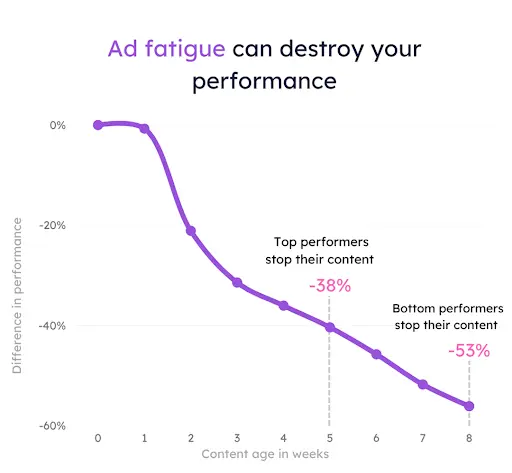
Even highly successful short-form video ads can lose effectiveness as audiences see them repeatedly. Over time, engagement may decline, CTRs may fall, and acquisition costs may increase.
This is known as ad fatigue, and it makes creative refreshes an important part of paid social campaign management.
Source: Neil Patel
Be ready for this from the start. That means shooting different angles and concepts, creating variations, and refreshing the creative just in time.
TikTok's video advertising guide recommends refreshing creatives every two to four weeks, or sooner if performance declines. However, the right frequency depends on audience size, campaign spend, and how quickly viewers are exposed to the same ads.
8. Create Platform-Specific Versions of Your Ads
TikTok, Instagram Reels, and YouTube Shorts all feature vertical, short-form video, but that doesn't mean the same creative will do well on every platform.
Each platform has its own viewing habits, content conventions, interface elements, and advertising options. Adapt your creative for them.
A practical starting point is to consider the following differences.
| Platform | Creative approach | Example |
|---|---|---|
| TikTok | Conversational, trend-aware, creator-led content with quick cuts | A creator showing a skincare product during their morning routine |
| Instagram Reels | Visually appealing lifestyle content, product demonstrations, and creator collaborations | A fashion brand showing several outfit combinations |
| YouTube Shorts | Concise demonstrations, tutorials, and creator-led explanations | A tech brand showing how a product solves a common problem |
These are creative starting points. Test the approaches that fit your audience.
9. End With a Clear Call to Action
Getting viewers to watch your video is only half the challenge. If your campaign aims to generate leads, sales, downloads, or website traffic, the ad should make the next step unmistakably clear.
Use a single, compelling call to action that matches your campaign objective. For example:
- • Ecommerce: "Shop the collection."
- • Lead generation: "Book your free consultation."
- • App installs: "Download the app."
- • Product discovery: "See how it works."
Don’t rely on the CTA offered by the ad platform. You can include the CTA in the voiceover, on-screen text, or a simple animated end card. Make sure it stays on screen long enough to read.
10. Measure Hook Rate, Hold Rate, and Conversions
CTR is useful, but it doesn't tell you everything about your short-form video ads. A viewer might watch most of an ad without clicking, while another might click quickly but never convert.
To better understand creative performance, look at video engagement metrics alongside your campaign's conversion results. That includes the already-discussed hook rate, but also other important metrics.
- • Hook rate: Measures how many people watch beyond the opening seconds. One common calculation is three-second video views divided by impressions, although definitions vary.
- • Hold rate: Indicates how well your video retains attention after the opening. For example, you might calculate the percentage of three-second viewers who continue watching to 15 seconds.
- • CTR and conversion rate: Show whether viewers take action after engaging with your ad.
You should also monitor average watch time, video completion rate, cost per acquisition, and ROAS where relevant.
Final Thoughts on Winning Short-Form Video Ads:
Improving short-form video ads pretty much comes down to getting the basics right: capture attention quickly, communicate one clear message, and present it in a way that feels natural to the platform.
Combine these principles with regular creative testing and performance measurement to find what resonates with your audience.
You don't need expensive production equipment or complex editing techniques to get started. If anything, short-form video ads have made ad production simpler and cheaper. But that doesn’t mean you can be sloppy with the strategy. Push a message that converts your audience, and use creators to deliver it.
Until next time, Be creative! - Pix'sTory
Recommended posts
-

Why Simple Video Edits Can Make Your Marketing More Effective
Read More › -

A Beginner's Guide to Working with Video Editors for Your Projects
Read More › -

How to Turn Static Designs Into Engaging Storytelling Videos (Even if You...
Read More › -

The Smart Data Revolution: How AI Video Generators Are Rewiring the Digit...
Read More › -
What Can an AI Video Editor Change? 6 Prompt-Based Edits That May Save a...
Read More › -

One Product Photo, Three Social Formats: A Crop-Safe Design Workflow
Read More ›