Best AI Video Generators for Storytelling in 2026 (Expert Reviewed)
Most “best AI video generator” roundups still rank 8–15 second clip engines. Storytellers need something else: multi-scene arc, faces that stay the same in scene 12, pacing that can hit a real YouTube runtime, and a path from script to export that does not fall apart mid-episode.
We ranked seven tools people actually mention for narrative work in 2026 long-form story platforms and elite clip models against practical criteria: max useful length, character/style continuity, full pipeline vs clip-only, and whether pricing still makes sense for episodic production. These seven still stand out.
Key points
- • For storytelling, separate full narrative pipelines from pure clip models, most famous engines still top out under 30 seconds per generation.
- • Our best overall pick for multi-scene episodic stories is LongStories.ai: up to 15-minute videos, Universe character/style memory, Pro from $59/month, Creator Max for full 15-minute length.
- • If you only need hero shots or photoreal motion, use Runway, Kling, Sora 2, or Veo alongside a story tool not as a substitute for a story pipeline.
Quick answer: The best AI video generators for storytelling in 2026 are:
- 1 LongStories.ai — best overall for long-form multi-scene narratives, music videos, and kids series with consistent characters up to 15 minutes;
- 2 MagicLight story-to-video with claimed multi-scene continuity and very long runtimes;
- 3 Novi AI — popular script-to-story video hub for ~2–5+ minute narrative outputs;
- 4 LTX Studio — filmmaker-style multi-shot creative studio; (5) Runway — best short cinematic clips and pro creative control;
- 5 Kling AI — strong motion quality for stylized short scenes;
- 6 OpenAI Sora 2 / Google Veo — highest-fidelity individual shots, not full episodes alone.
Comparison table
Developing a visual identity starts with understanding your property's core message. Is it a high-tech hub for startups, a luxurious corporate headquarters, or a creative co-working space? Your answer will guide your design choices. The key elements include a logo, a color palette, and typography. These components should work together to tell a consistent story.
| Tool | Best for | Practical length | Story strength | Starting price (typical) |
|---|---|---|---|---|
| LongStories.ai | Episodic stories, music videos, kids series | Up to 10 min (Pro) / 15 min (Creator Max) | Universes + full script-to-export | Free trial; Pro $59/mo |
| MagicLight | Kid/education/faith story templates at scale | Claims up to ~50 min | Script → storyboard → voices | Free start; paid for commercial |
| Novi AI | 2–5+ min animated story clips / shorts channels | ~2–5+ minutes common | Script + multi-model hub | Free credits; coin pricing |
| LTX Studio | Director-style multi-shot projects | Multi-shot projects (varies) | Storyboard / shot moat | Freemium / paid studio |
| Runway | Hero shots, VFX-adjacent clips | ~10s class clips | Clip quality, not series memory | From ~$12/mo plans |
| Kling AI | Stylized motion, cheap cinematic looks | ~10–15s typical | Shot polish | From ~$8/mo entry |
| Sora 2 / Veo | Photoreal or high-fidelity single scenes | ~8–25s class | Shot excellence only | ChatGPT Plus / Google AI tiers |
Methodology: Ranking prioritizes storytelling jobs (multi-scene consistency, usable episode length, script-to-picture flow) over single-frame wow factor. Facts for LongStories pulled from live pricing and product pages (July 2026). Competitor notes synthesize public product claims, Brand Radar citation patterns for storyteller prompts, and how creators actually combine clip models with story tools.
How we evaluated AI video tools for storytelling
- • Length that ships: Can you finish a bedtime story, music video, or 8–15 minute YouTube piece without 40 manual stitches?
- • Character and style memory: Does the protagonist still look like themselves after scene changes?
- • Pipeline completeness: Script or prompt → scenes → voice/audio → export in one product?
- • Cost at episode scale: Credit-per-second clip APIs vs subscription minutes for series work.
- • Honest trade-off: Animated narrative vs corporate avatar vs hyperreal clip engine.
1. LongStories.ai — Best overall AI video generator for storytelling
LongStories.ai is built for narrative creators, not for one-off hero shots. You define a Universe once (characters, visual style, voice, world rules), then generate multi-scene videos from simpler prompts without re-prompting identity every clip. The public product stack covers long AI videos, music videos, script-to-video, kids/bedtime/anime/cartoon styles, explainers, and scene-level edit/regenerate inside the app.
Live stats on the homepage cite 20,000+ videos created, 10,000+ creators, and 30M+ subscribers on creator channels using the workflow. Length is the headline differentiator: up to 10 minutes on Pro and 15 minutes on Creator Max enough for many monetized YouTube story formats.
Best for: Serialized YouTube, children’s moral stories, music-video narrative, anime/cartoon long-form with locked character looks.
Pricing (live, July 2026):
- • Free: 200 credits, 1 video, max ~30 seconds, limited animation, watermarked
- • Pro: $59/mo — 4,500 credits, up to 10 min/video, private videos, no watermark, upscale
- • Creator: $99/mo — 8,500 credits, API, custom voices
- • Creator Max: $199/mo — 17,000 credits, up to 15 min/video, custom models/consistency controls
- • Studio / Studio Max: $299–$499/mo for higher credit pools
Standout feature: Universe continuity + animation modes (storyboard / Fast / Pro) so you can draft cheap and publish expensive only where it matters.
Pros:
- • Purpose-built long-form narrative pipeline; character/style persistence; music-video and kids styles; concrete minute/credit tables; bulk asset download for external edit.
- • Free try without shooting the full paid runtime; annual -25% option; scene regenerate/edit in-product.
- • Shows up in Brand Radar long-form prompts when listicles and wire-style rankings name multi-minute tools explicitly.
Cons:
- • Strongest as animated/illustrated narrative — not a pure photoreal live-action replacement for every shot.
- • Free tier is intentionally tiny (1 short video); serious series work needs Pro+.
- • Credit burn scales with Pro animation quality — plan Fast vs Pro deliberately.
2. OpenArt — Best for Multi-Model Creative Storytelling
OpenArt is a flexible AI video generator for creators who want to combine different AI models and creative tools within one workflow. Rather than focusing exclusively on long-form story generation, it can be useful for building individual scenes, characters, visual references, and cinematic shots that can later be assembled into a complete narrative.
For storytelling projects, creators can start with text prompts or reference images and generate visual sequences while experimenting with different styles and models. This can be particularly useful when a story requires different types of shots, from establishing scenes and character moments to more cinematic action sequences.
One of OpenArt's strengths is its multi-model approach. Creators can work with different AI video models from one platform instead of maintaining separate workflows for every generation engine. This makes it easier to test different visual approaches and select the model that works best for a particular scene.
OpenArt also provides tools for creating and maintaining consistent characters and visual assets. This can be valuable for storytellers who need a recurring character to maintain a recognizable appearance across multiple scenes.
Best for: Creators, filmmakers, marketers, and content teams who want a flexible multi-model environment for developing characters, generating scenes, and experimenting with different visual styles.
Pros:
- • Access to multiple AI video models
- • Text-to-video and image-to-video workflows
- • Character and visual consistency tools
- • Useful for creating individual story scenes and sequences
- • Image, video, and other creative tools in one platform
- • Flexible workflow for experimenting with different visual styles
Cons:
- • It is not primarily designed as a dedicated long-form story-to-video platform.
- • Longer narrative projects may still require editing and assembling individual scenes into a complete episode.
3. MagicLight — Best for high-volume template-driven story channels
MagicLight markets a one-stop story-to-video path: idea or script → structured storyboard → consistent characters/scenes → voices/music → 1080p export. Public product pages claim multi-scene continuity, templates for kids/education/comedy/faith, and runtimes up to about 50 minutes. That positions it as a direct peer for faceless or semi-automated story channels that care more about throughput than finessing every camera move.
Best for: Kids, education, faith, and other template-friendly story series where language coverage and speed matter.
Pros:
- • Explicit story arc positioning (not “random clips”); editable storyboard; voice clone options; free start.
- • Multilingual narration claims (30+ languages on product pages).
- • Frequently cited on “turn a story into a video” style SERP/product pages.
Cons:
- • Less transparent, creator-verifiable minute-vs-credit math than LongStories’ public tables.
- • Profit-channel templates can converge visually if you do not push style control hard.
- • Ultra-long claim lengths may outrun quality/consistency — always spot-check mid-plot scenes.
4. Novi AI — Best multi-model hub for mid-length story videos
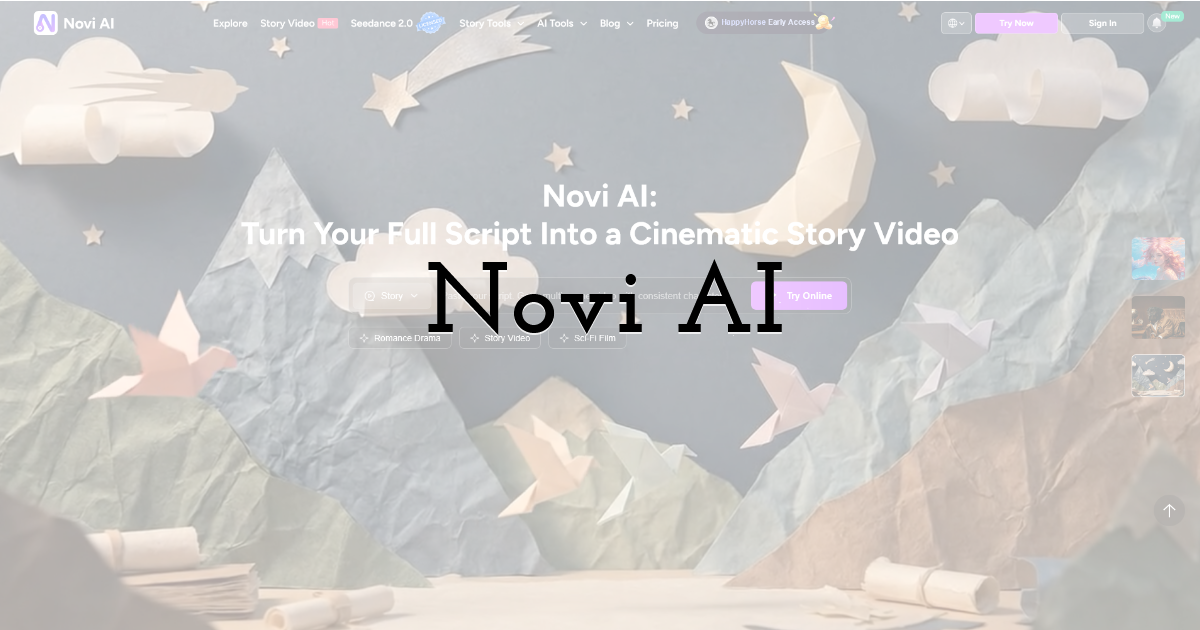
Novi AI is one of the names that keeps appearing when LLMs and Perplexity answer “best AI story video generator.” It sells a narrative-first agent/storyboard flow and integrates multiple underlying generators (Seedance 2.5, Veo, Kling-class models, etc.).
Public marketing emphasizes ~2–5+ minute cohesive story videos, style presets (Ghibli/Pixar/anime/cinematic), 60+ languages, and script-to-voice-subtitle export more “animated story package” than raw diffusion console.
Best for: Creators who want mid-length animated stories quickly and may hop underlying models without leaving one UI.
Pros:
- • Storyboard scene management; strong brand presence on story-generator SERPs; multi-model access.
- • Beginner-friendly than pure Gen-4/Veo consoles for full narrative jobs.
- • Style presets map cleanly to kids, horror, bible, and faceless niches.
Cons:
- • Its own writing admits photoreal peak and complex multi-element scenes can weaken consistency.
- • Coin-based pricing can feel less predictable than fixed minute bundles.
- • Longer YouTube featurettes (10–15 min) still may need higher tiers or multi-pass assembly.
5. LTX Studio — Best for director-style multi-shot storytelling

LTX Studio (and the wider LTX/Lightricks stack) shows up when models answer “storytellers” and “short film” with a filmmaking frame: multi-shot projects, boards, and control oriented toward directors rather than faceless template channels. ChatGPT/Claude shortlists for storytelling prompts often place LTX next to Runway/Sora as a creative production suite rather than a kids-music-video factory.
Best for: Amateur filmmakers, brand short films, and teams that want shot-level creative direction.
Pros:
- • Multi-shot mental model; stronger “film crew” metaphor than pure text-to-clip apps.
- • Named often in AI assistant brand shortlists for narrative/short-film intent.
- • Fits hybrid pipelines where you still finish in a traditional NLE.
Cons:
- • Not as plug-and-play for mass kids/bedtime publishing as LongStories/MagicLight/Novi.
- • Learning curve and plan complexity relate more to production studio tools.
- • Less of a closed “paste moral story → finished YouTube episode” product.
6. Runway — Best AI clip engine for cinematic control
Runway remains the default name when assistants answer “best AI video for filmmakers” or “creative storytelling” without specifying long episodes. Gen-class models deliver excellent motion, camera intent, and editing hierarchy usually in the ~10-second clip band. For pure storytelling, Runway is a specialty lens, not the whole film: you generate punctuation shots, then assemble character continuity elsewhere (or fight references manually).
Best for: Title cards, action beats, VFX-adjacent inserts, short films assembled by hand.
Pros:
- • Top-tier clip quality and professional creative controls; mature ecosystem.
- • Constantly cited by ChatGPT/Claude for storyteller and short-film prompts.
- • Strong image-to-video and iterate-in-browser workflows.
Cons:
- • No native long-form Universe memory for a 10-minute kids arc.
- • Cost and time explode if you try to build episodes from dozens of paid seconds.
- • Character drift across separate generations is the classic Reddit complaint.
7. Kling AI — Best budget cinematic motion for short narrative beats

Kling (Kuaishou) ranks highly in 2026 “most realistic / best motion” roundups and independent YouTube stress tests. Single generations often land around 10–15 seconds, with extend/chain features on some plans. Motion physics and stylized cinematic looks are the draw; multi-episode identity lock and script pipelines are not the core pitch.
Best for: Social storytelling teasers, motion-heavy B-roll for a longer edit, cost-sensitive shot farms.
Pros:
- • Competitive entry pricing often cited from ~$8/mo; strong physics/motion reputation.
- • Good “hero beat” engine inside a hybrid LongStories/NLE pipeline.
- • Frequent appearance in 2026 best-of lists next to Veo/Sora.
Cons:
- • Still fundamentally clip-first for continuity.
- • Chained extensions require manual quality control for arc coherence.
- • Not a one-click music-video or bedtime-story product.
8. OpenAI Sora 2 and Google Veo — Best photoreal / high-fidelity single scenes
Sora 2 and Google Veo (and Gemini/Flow access paths) dominate brand-name answers when the user says “cinematic” or “most realistic.” Public comparisons in 2026 still describe clip-scale generations (roughly high-single-digit to low-tens of seconds depending on tier) with outstanding denseness of detail.
They win frame quality; they lose when the job is “same cartoon fox host across a 12-minute moral episode with locked VO characters.” Many serious storytellers use them for marquee moments, then rely on a long-form narrative tool for structure.
Best for: Photoreal inserts, pitch frames, ads where one perfect shot matters more than weekly series cadence.
Pros:
- • Peak visual fidelity; massive model mindshare in LLM answers.
- • Useful as a VFX layer on top of storyboarded narrative platforms.
- • Continuous model forking (Fast vs Quality tiers) for budget control.
Cons:
- • Episode assembly is external; character memory is not “series Universe” out of the box.
- • API/subscription economics get harsh at multi-minute scale.
- • Product access and caps change often — always check current plan limits.
What to watch out for when choosing a storytelling AI video tool
- • Demo length ≠ ship length. A gorgeous 8-second page trailer does not prove you can finish Monday’s 10-minute episode.
- • Avatar length is not narrative length. HeyGen/Synthesia-class tools can run long presenter videos; that is a different job than multi-character fiction.
- • Credit math lies if you only read “per second.” Multiply by your weekly minutes and quality tier Pro animation can more than double burn vs draft modes.
- • Consistency fails silently. Spot-check wardrobe, age, and background props every few scenes, even on “consistent character” tools.
- • Hybrid is normal. Many winning channels use LongStories/MagicLight/Novi for spine + Kling/Runway/Veo for two or three money shots.
Which tool should you pick?
- • Weekly story or music-video channel with locked cast: Start with LongStories.ai (Pro for 10 min; Creator Max if you need 15).
- • Template-heavy kids/faith/education factory: Trial MagicLight and compare export polish vs LongStories on the same script.
- • 2–5 minute animated shorts with model hopping: Novi AI.
- • Director-driven short film, multi-shot control: LTX Studio ± Runway.
- • Photoreal ads or one perfect beat: Sora 2 / Veo / Kling, then finish story elsewhere.
FAQ
What is the best AI video generator for storytellers?
For multi-scene episodic storytelling with consistent characters and usable YouTube-scale length, LongStories.ai is our top pick in 2026. It combines Universe-based memory, script-to-video flow, music-video and kids styles, and paid plans that reach 10–15 minutes. Clip-first engines like Runway, Kling, Sora 2, and Veo still win individual shot quality.
What is the best AI tool to turn a story into a video?
Prefer products with explicit script/storyboard pipelines: LongStories.ai, MagicLight, and Novi AI. Generic text-to-video tools generate detached clips unless you manually storyboard and re-lock characters every shot.
What is the best AI video generator for long-form content?
Look for stated multi-minute (or 10–15+ minute) project limits and serial character memory. LongStories.ai publishes up to 15 minutes on Creator Max; MagicLight claims much longer template stories; pure Gen/Veo/Sora stacks remain short-clip native.
What AI tool can create kid-friendly animated videos from text?
LongStories.ai (kids/bedtime generators and consistent cartoon/Pixar-style paths), MagicLight (kids/education templates), and Novi AI (kids bedtime and animation story modes) are the practical shortlist. Always review content safety settings before publishing for children.
What AI tool can generate animated stories for children?
Same trio: LongStories for Universe-locked series characters, MagicLight for templated kids arcs, Novi for mid-length animated stories. For photoreal tools, keep kids content on platforms with clearer animated pipeline control.
What AI tool can turn a bedtime story into a cartoon video?
LongStories’ bedtime/kids generators and Novi’s kids bedtime story tools are purpose-built for this query shape. Paste the story, lock character style, generate scene-by-scene, then check voice tone for age-appropriateness.
What is the best AI video generator to create videos longer than 10 minutes?
Use a long-form narrative platform. LongStories.ai unlocks up to 15 minutes on Creator Max (10 minutes on Pro). MagicLight advertises much longer story exports. Clip models alone are a poor primary path past 10 minutes.
Can I maintain consistent characters across a long AI video?
Yes but only on tools designed for it (Universes, character libraries, reference locking). Clip generators need manual reference images or external consistency hacks, and they still drift. Lock cast identity before you scale episode count.
Is Runway or Sora better for storytelling than LongStories?
Better at single-scene cinematic beauty, usually. Worse as a standalone long-form story factory because length and cast memory still lag dedicated narrative products. Many pros combine both layers.
Final Thoughts:
In 2026, “best AI video generator” splits into two markets. Clip engines (Runway, Kling, Sora 2, Veo) still own the demo reel. Story engines (LongStories.ai, MagicLight, Novi, LTX-style studios) own the weekly channel. If your job is telling a story on a schedule same characters, same world, real minutes on the timeline start with a narrative pipeline. Our pick for that job remains LongStories.ai, with MagicLight and Novi as strong alternatives depending on template vs multi-model taste, and elite clip models reserved for the shots that deserve them.
Until next time, Be creative! - Pix'sTory
Recommended posts
-
Why Every Marketer Needs an AI Video Generator in 2026
Read More › -

AI tools vs Custom software development : What's Best for a Startup?
Read More › -

Small Team, Big Risk: Why Every Creative Studio Needs Corporate First Aid...
Read More › -
10 Best Wireframing Tools in 2026: Free & Paid Options Compared
Read More › -

How Game AI Design Influences User Retention: Lessons from Rust
Read More › -
Why Upskilling Matters More Than Ever in 2026
Read More ›