Why Detector.io Free AI Detector Has a Place in Every Class

AI writing is no longer a side topic on campus. It sits inside real student routines: polishing intros at midnight, fixing awkward phrasing before class, and checking whether a paragraph sounds too smooth to feel fully human. That shift has changed the writing process itself.
Students now need a way to review their own drafts before submission, especially when they have used digital help at some stage. Running the draft through an AI detector can help identify passages that may need closer review and more personal detail. Detector.io fits that new reality well. The platform offers a fast scan, clear results, and extra writing tools that support revision after the first check. For students who want an AI detector free of charge, the appeal is simple: paste text, review the result, and decide what still needs work before sending an assignment across the finish line.
The AI Wave Reaching Every Classroom

A few years ago, most classroom worries around writing centered on plagiarism, citation gaps, or weak structure. Now the conversation has widened.
Students brainstorm with chatbots, ask for outline help, clean up grammar with smart editors, and test thesis ideas in seconds. That does not always mean they are outsourcing the whole assignment. In many cases, they are using AI the same way they use spellcheck, tutoring videos, or study forums: as support during a stressful week.
The hard part is that support can leave traces in the final draft. A paper may still reflect the student's ideas but carry a rhythm that feels overly even or a paragraph that sounds generic.
Detector.io speaks directly to this tension, advising students to review essays before submission and watch for text that may trigger suspicion. That makes detection part of revision.
Detector.io as an AI Content Detector for Student Writing
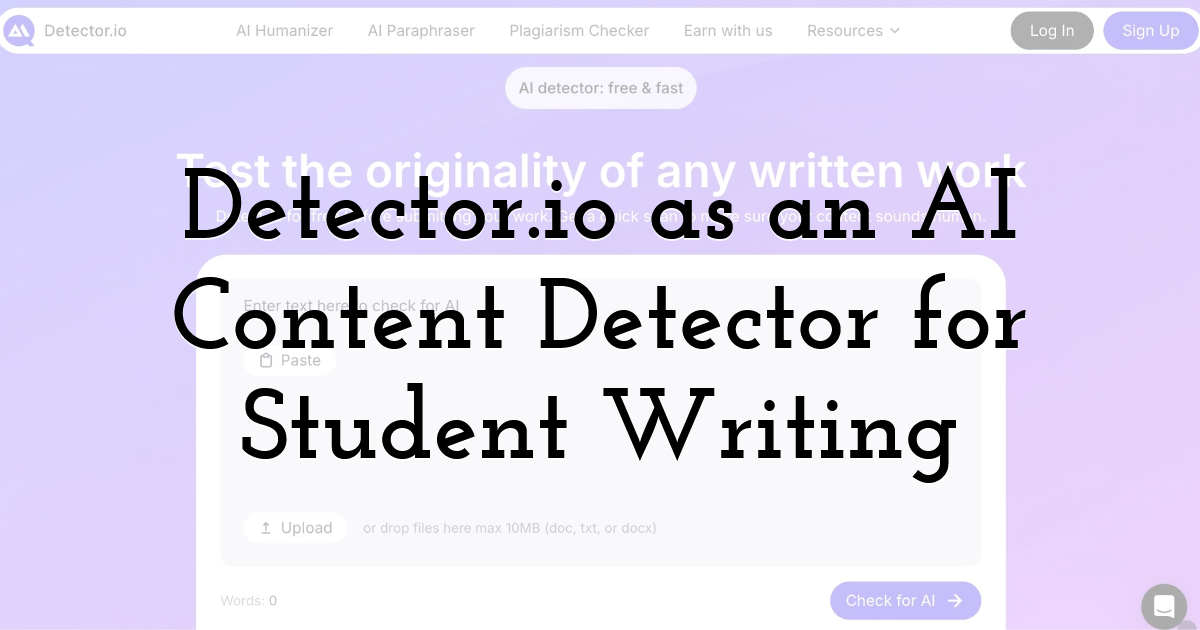
The platform keeps its core promise simple. Detector.io says users can paste text into its ai checker, run a fast scan, and get clear results without payment. It looks for patterns often associated with machine-written text, including repetitive phrasing, regular sentence flow, and writing that lacks natural shifts. The site also says the detector currently supports English and allows scans up to 3,000 words per use.
That setup makes the tool easy to picture inside a real study session. A student finishes a literature response, drops it into this AI text detector, and sees which parts deserve a second pass.
These features are part of the appeal:
- • Fast essay scanning
- • Sentence-level review support
- • Probability-based results
- • Browser-based access
- • Useful limit for full drafts or large sections
Detector.io also explains that flagged text does not have to become a dead end. The platform points users toward revision help when a section needs smoothing, which makes the tool feel practical for students who want to improve a draft instead of panicking over a score.
How to Use the AI Detector Before Submitting Assignments
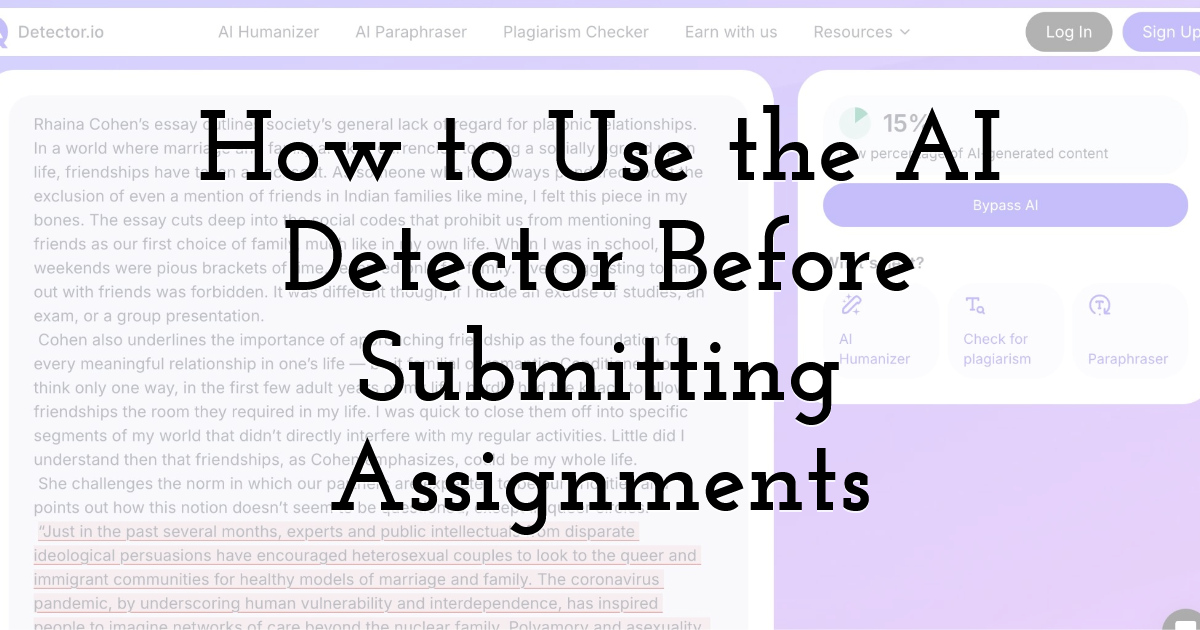
The strongest use case here is self-checking. A student writes the draft, maybe gets help with structure from an AI chatbot, revises it, and then runs the final version through Detector.io before uploading it to class.
That process creates a pause between drafting and submitting. In that pause, the student can see whether some parts still sound too polished, too flat, or too pattern-based. Detector.io recommends exactly this kind of proactive review in its academic writing guidance.
The workflow is straightforward:
- • Check an essay after the final draft
- • Review paraphrased passages with extra care
- • Rewrite sections that feel stiff or generic
- • Run one more scan before submission
This matters because many students are not trying to game the system. They are trying to avoid misunderstandings. A scholarship essay, reflection paper, or research response can pick up artificial-sounding phrasing during editing. Seeing those spots early gives the student a chance to add more specific detail, restore a natural voice, and make the writing feel lived in rather than assembled.
A Larger Academic Toolkit Beyond an AI Detector Free Tool
Detector.io is also broader than one checker. The site includes an AI Humanizer, an AI Paraphraser, and a Plagiarism Checker, all framed as support for rewriting, refining, and reviewing text.
That mix suits the way students actually work. You scan a draft. A few sections look risky. You revise them. One paragraph still sounds wooden, so you use the humanizer to loosen the tone. Another section needs a cleaner phrasing change, so the paraphraser helps reshape it. Then you read the whole piece again and decide whether it still sounds like you.
Academic toolkits are getting more layered, and Detector.io seems built around that reality. It is less a one-click verdict machine and more a compact revision station for busy students moving between ideas, edits, and deadlines.
What Tools Like Detector.io Mean for the Future of Student Writing
The bigger story is not that detectors will replace judgment. They are becoming normal checkpoints in digital writing. As AI stays embedded in study habits, students will likely keep adding verification to the final stage of revision. Detector.io already reflects that model: scan, inspect, revise, and submit.
The AI detector free online pairs detection with companion tools because modern writing no longer moves in a neat line from draft to final copy. It loops through assistance, editing, checking, and reshaping.
For classrooms, that points toward a more realistic future. Students will still need to think, argue, research, and sound like themselves. Tools can help them protect that voice when the digital noise gets loud.
Detector.io has a place in that process because it meets students where they already are: inside messy drafts, late-night revisions, and the pressure to submit work that feels polished and genuinely theirs.
Final Thoughts:
Detector.io makes sense in student writing workflows because it matches the way academic work now gets done. It gives users a fast check, highlights areas worth revisiting, and adds extra tools for revision after the scan.
In a classroom shaped by AI-assisted drafting, that kind of support feels practical. Students still need to bring their ideas, judgment, and personal voice. A tool like this helps them review the draft with sharper eyes before they hit submit. It can also give educators a useful signal during feedback, but the real strength here is student agency: checking your own work, revising calmly, and understanding what your draft is communicating.
Until next time, Be creative! - Pix'sTory
Recommended posts
-

How Computer Vision with AI Improves Business Efficiency
Read More › -

The Secret of Killer Marketing: Email and Instagram Give Benefits When Wo...
Read More › -

How to Create Stunning Logos with AI
Read More › -

Top 5 Trends In 3D Architectural Renderings For 2026
Read More › -

The Invisible Search Layer Most Brands Are Missing (And How Smart Markete...
Read More › -
How Lip Sync AI Solutions Cut Editing Time
Read More ›