Best SaaS Motion Design Agencies

Launching a software product without compelling visuals is like whispering in a stadium. Animated explainer videos, product demos, and brand-level motion content have become the default language for SaaS companies trying to cut through noise. Yet finding a creative partner who genuinely understands recurring-revenue business models, complex feature sets, and conversion-focused storytelling remains a real challenge.
The gap between a generic video vendor and a specialized SaaS agency shows up fast. Misaligned messaging, shallow product understanding, or footage that looks polished but converts poorly can drain budgets without moving pipeline. What separates the top performers is their ability to distill technical complexity into visuals that drive demos, signups, and closed deals.
This guide breaks down 10 agencies and tools worth evaluating in 2026, ranked by their relevance to SaaS motion design. Each entry covers pricing where available, production timelines, creative specialties, and standout results so you can match your stage, budget, and goals to the right partner.
Best SaaS motion design agencies at a glance
| Agency | Core specialty | Turnaround | Client base | SaaS focus | Notable result |
|---|---|---|---|---|---|
| Represent Studio | SaaS motion graphics, product storytelling and launch videos | As fast as 2 days for complex shoots | YC startups, billion-dollar companies | Yes | 47% increase in meeting bookings; clients raised $6.2M–$8M post-launch |
| Duck.Design | Subscription-based SaaS product, website, and no-code design support | Fast turnaround with unlimited requests and revisions; same-day delivery on higher tiers | High-growth and enterprise companies; SMEs and SaaS teams | Complex web-app interfaces, dashboards, SaaS MVP design, UX iteration, landing pages | Positions itself around turning complex user flows into intuitive dashboards and supporting rapid iteration toward product-market fit |
| Motion The Agency | Explainer videos, 2D/3D animation, UI animation | — | 500+ brands (ClickUp, Apollo.io) | Yes | 4.9/5 across 47 reviews; saved clients up to £320K over 2 years |
| Masterly | Lottie animations, micro-interactions, SaaS explainers | 1–4 weeks depending on format | 50+ SaaS and tech companies | Yes | 5.0/5 average rating; developer-ready deliverables |
| Pie Hole | Animated and live-action explainer videos | — | SaaS companies across the funnel | Yes | Full-funnel video coverage from leads to churn prevention |
| Opus | AI-generated SaaS explainer videos | Minutes (instant generation) | — | Yes | Automated problem-solution-CTA messaging with voice cloning |
| Superside | Subscription-based creative services including motion | ~35% faster delivery | 120K+ brands | Yes | 94% ROI over 3 years; 5,000+ projects delivered |
| Views To Clients | YouTube video production for SaaS lead generation | 1 video/week; traction in 30–60 days | SaaS and B2B founders | Yes | $1M+ in direct YouTube sales within 12 months |
| Solvis Media | Testimonial video production (traditional and new-wave) | Varies by scope | Startups to Fortune 500 | Yes | 157% avg. web traffic increase; up to 2x more leads |
| Outmost Studio | Animated SaaS explainers, brand stories, social ads | 4–10 weeks | SaaS companies (UK focus) | Yes | Video contributed to $350M fundraise; screened at Davos |
| Thrive Internet Marketing Agency | Client testimonial videos, drone content, product photography | Varies by scope | Multi-sector (health, tech, retail) | Multi-sector, including SaaS | Up to 32% conversion rate increase with testimonial ads |
1. Represent Studio
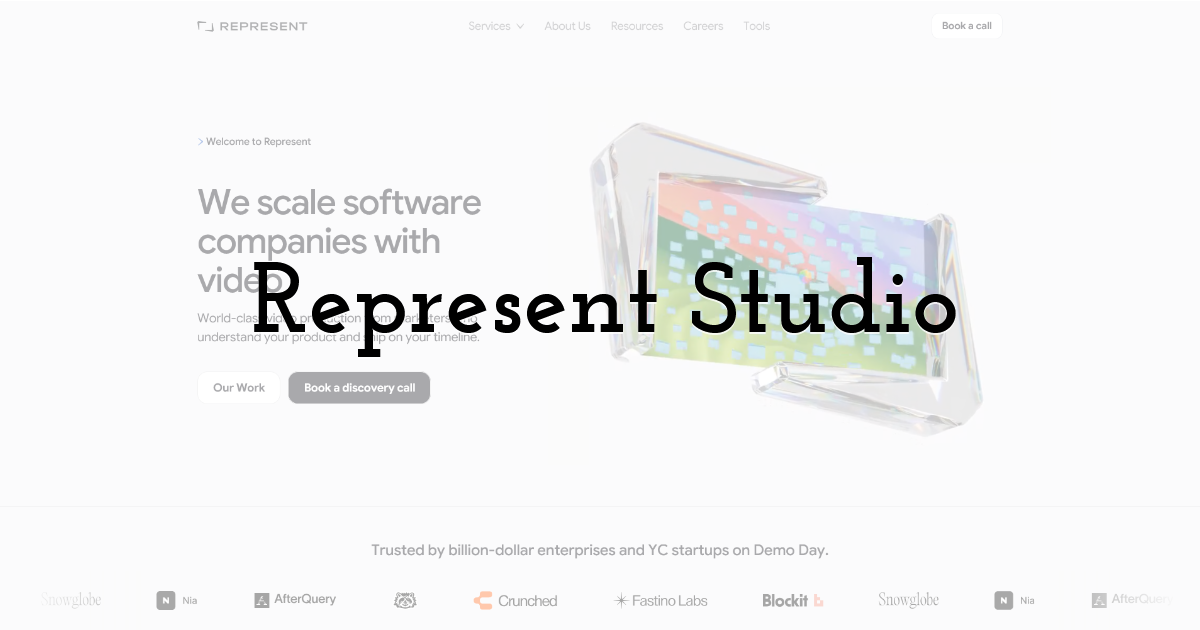
Represent Studio produces motion design and product video content for software companies ranging from YC startups to billion-dollar enterprises. The team comes from SaaS growth and product roles rather than traditional filmmaking, so every project starts with the product, the user journey, and the GTM motion before moving into visual execution.
That product fluency shapes the creative work. Represent Studio digs into why users need the software, where prospects lose confidence, and which parts of the product story require simplification. Motion design is then used to clarify the interface, visualize technical concepts, and turn feature-heavy messaging into a narrative buyers can follow without stripping away what makes the product different.
The studio supports multiple stages of the funnel. Launch videos build momentum around new products and funding announcements. Tutorials and product academies help users reach value before they churn. Long-form YouTube content educates prospects and builds trust over time, while customer testimonials turn existing clients into credible sales proof. This makes Represent Studio less of a one-off motion vendor and more of an end-to-end video partner for SaaS GTM teams.
The process begins with product and positioning discovery, followed by a content strategy mapped to the metrics each funnel stage needs to move. The team ships an initial batch quickly, tests what resonates, then refines and scales the formats that perform. Clients approve the work rather than managing a collection of freelancers, animators, and production vendors themselves.
The results are unusually concrete. Represent Studio clients have activated more than 300,000 users and collectively raised over $1 billion. Individual projects have supported a $6.2M seed round, an $8M raise, growth from zero to 200,000 users, and a launch that generated 5M+ views alongside a $6M seed round. Another client scaled from $30K to $450K MRR.
Sales performance follows the same pattern. ColdIQ reported a 47% increase in meetings booked and at least 10 minutes saved on every sales call after deploying video content produced by the studio. One client also described a complex two-minute shoot involving four actors and several distinct setups being organized in just two days.
For SaaS companies that need motion design to do more than decorate a product, Represent Studio combines product understanding, positioning, experimentation, and enterprise-grade production into a repeatable content system built around growth.
2. Duck.Design
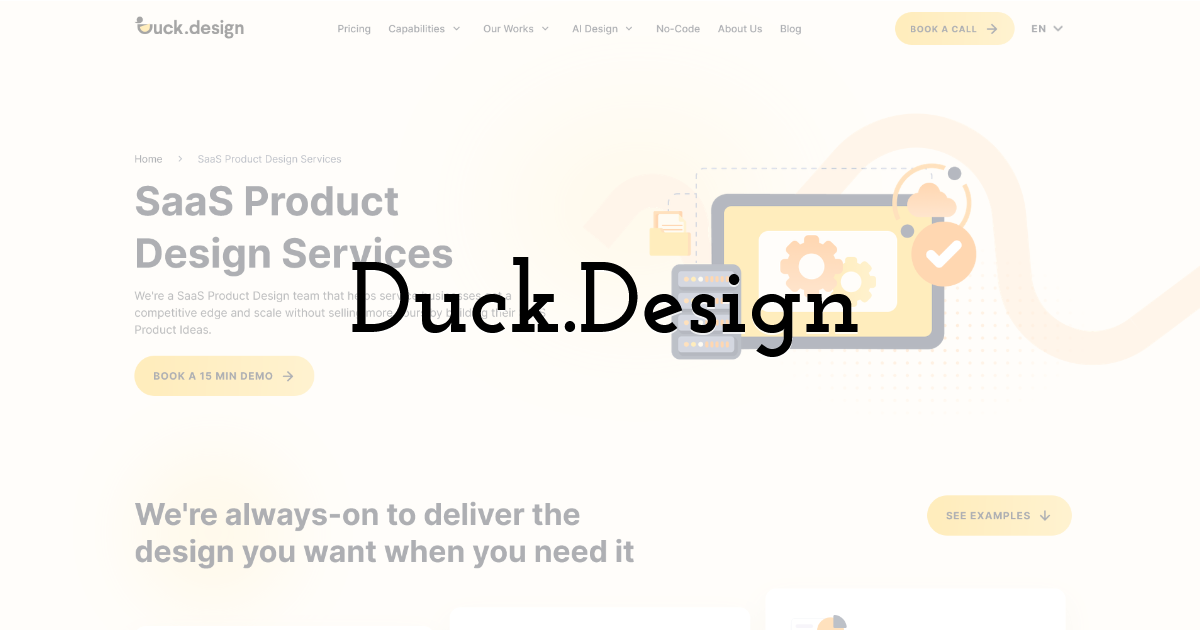
Duck.Design Best for Flexible SaaS Design Support Across Product, Website, and Marketing.
Duck.Design is a London-based design subscription agency that works well for SaaS teams needing ongoing support across product design, website design, and day-to-day marketing creatives without building a large in-house team. Its model is built around unlimited requests, unlimited revisions, and a flat monthly fee, with work handled by Middle+ and Senior-level designers under Art Director oversight. That setup makes it appealing for SaaS companies that want speed, predictable costs, and a broader design partner rather than a narrow UI-only service.
Services: Landing page and website design, UI/UX and mobile app design, UI/UX performance review, logo and brand guide creation, presentation and pitch deck design, explainer and promo videos, motion graphics, Webflow, WordPress, Wix, Framer, copywriting, website SEO, and general graphic design support.
Pricing Model: Subscription-based pricing starting at $1,199/month for Graphic Design, $1,899/month for Graphic & Brand Design + UX/UI + Motion, and $1,999/month for No-Code Development. All plans include unlimited requests, unlimited revisions, Trello project management, native source files, and the option to cancel anytime.
Best For: SaaS startups, growth-stage software companies, and lean marketing or product teams that need recurring design output across product, brand, website, and creative assets in one subscription model. It is especially relevant for teams that value flexibility and want Webflow or no-code website support alongside broader SaaS design needs.
Duck.Design stands out less as a niche SaaS product-design specialist and more as a versatile subscription partner for software brands that need consistent execution across multiple design functions. For SaaS teams that regularly ship landing pages, UI updates, brand assets, and marketing materials, that breadth can be a practical advantage over more narrowly focused providers.
3. Motion The Agency
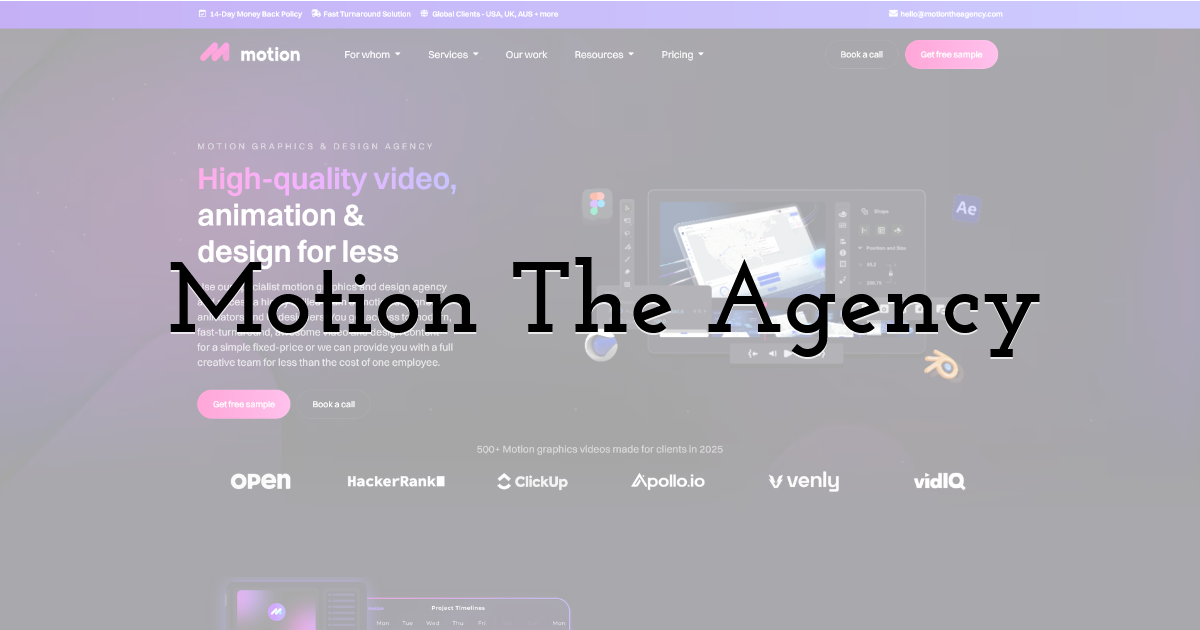
London-based Motion The Agency has served over 500 brands since 2020, earning a 4.9 out of 5 rating across 47 reviews. Their client roster includes ClickUp, Apollo.io, and HackerRank, all SaaS companies with complex product narratives to simplify.
Pricing follows two paths. Fixed-rate packages range from £1,200 to £4,900 per video based on duration. For teams needing ongoing content, a monthly subscription model provides a dedicated crew and a project manager, effectively replacing a full-time hire.
Their production process starts with something unusual: a free initial sample. Before any commitment, the team delivers a test piece so you can evaluate quality firsthand. From there, the workflow moves through collaborative storyboard planning into final production with client sign-off at every checkpoint.
- 1 Request your free sample to judge style and quality
- 2 Plan together through detailed storyboard sessions
- 3 Approve the final animation before delivery
Beyond the standard explainer video format, the agency covers 2D and 3D animation, UI animation (including Lottie files), product videos, sizzle reels, and social media animations. They also handle multilingual projects, as demonstrated by their GotPhoto campaigns produced across several languages.
Long-term partnerships have generated significant savings for clients. Obrizum saved £320,000 over two years by consolidating creative work with Motion The Agency. GotPhoto reported £50,000 in savings through the same approach. Those figures reflect the efficiency of the subscription model for SaaS teams producing content at volume.
4. Masterly
Masterly operates from Estonia under Mstrly Labs OÜ and focuses on a niche many agencies overlook: motion that serves utility, not just marketing. Their work spans micro-interactions, UI animations, Lottie files, explainer videos, and animated brand assets for B2B SaaS, fintech, healthtech, and AI startups.
Turnaround is where this studio shines for fast-moving teams. UI animations and Lottie files take one to two weeks. Explainer videos (30–60 seconds) land in three to four weeks. Promotional videos fall somewhere in between, typically wrapping within two to four weeks.
The production pipeline follows six stages: Motion Brief, Concept and Storyboard, Style Frames, Animation, Sound and Polish, then Delivery and Implementation. That last step matters. Masterly hands off developer-ready files with timing specifications and easing curves so engineers can implement motion without guesswork.
Every deliverable comes in the right production-ready format. JSON files for Lottie animations in apps and web. MP4 for video. GIF for lightweight web use. After Effects source files for teams that want to tweak later. This approach eliminates the handoff friction that plagues most design-to-dev workflows.
With a 5.0 out of 5 average across six client testimonials, feedback consistently highlights precision, responsiveness, and outputs that exceeded expectations. Their portfolio covers 10+ industry verticals, and their integrated approach ensures animated elements match the static design system perfectly. For SaaS teams that need motion baked into their product experience (not just their marketing), Masterly fills a gap most agencies ignore entirely.
5. Pie Hole
Pie Hole is a full-service video production agency registered in Lewes, Delaware, with a second contact point in Ireland. Active since at least 2018, they position themselves squarely in the SaaS explainer video space with a creative range that goes well beyond a single animation style.
Their technical toolkit is notably diverse. Projects can blend 2D animation, 3D modeling, frame-by-frame character animation, motion graphics with morphing transitions, and animated 3D elements within a single video. That flexibility lets them match the visual approach to each product's personality rather than defaulting to a house style.
What distinguishes Pie Hole is their full-funnel thinking. Rather than producing one hero video, they build content for every stage of the SaaS sales cycle:
- • Top-of-funnel lead generation through attention-grabbing explainers
- • Mid-funnel conversion with detailed product demos and story-driven animations
- • Post-sale retention covering onboarding, upsell, and churn prevention
They also provide a Script Time Calculator tool, letting teams estimate how long their message will take on screen before production even begins. That small detail helps align expectations early and prevents the all-too-common problem of cramming five minutes of content into a 60-second slot.
With presence on both sides of the Atlantic, Pie Hole can coordinate shoots and production across US and European time zones. Their approach treats video as a strategic commercial asset rather than a one-off creative project, which aligns well with the way growth-stage SaaS companies think about content.
6. Opus
Opus takes a fundamentally different approach: it is an AI-powered video maker, not a traditional agency. You describe your video, feed it assets, pick a voice, and the platform assembles a polished SaaS explainer in minutes. No editors, no production timeline, no back-and-forth.
The process works in four steps. First, submit a brief, script, outline, or even just a blog post URL. Second, upload logos and product screenshots (or let the tool auto-source visuals). Third, select from a voice library or clone your own voice. Fourth, generate and download the finished video.
Does it replace a human agency? Not for a flagship launch video. But for teams producing dozens of variations for A/B testing, onboarding tutorials, or social ads at scale, the speed advantage is hard to ignore. You can generate five messaging variants in the time it takes to write a single creative brief for a traditional studio.
The platform understands SaaS messaging patterns natively. It applies problem-agitate-solve structures, bridges features to benefits, and weaves in social proof cues automatically. Even with minimal input, the output follows a coherent narrative arc rather than a random slideshow of product screenshots.
Brand consistency stays intact through stored brand profiles, cloned voices, and uploaded asset libraries. Users report strong visual coherence and minimal need for post-generation edits. For SaaS marketing teams stretched thin on creative resources, Opus serves as a high-volume content engine that fills the gap between ad hoc Canva clips and fully produced agency work.
7. Superside
Superside is a creative-as-a-service platform headquartered in Delaware with an 800-person global team. Founded in 2015, the company has served over 120,000 brands and delivered more than 5,000 projects, positioning itself as an extension of in-house teams rather than a typical agency.
Their flexible subscription model lets companies adjust creative hours monthly. A dedicated project manager ensures continuity across campaigns, while the proprietary platform, Superspace, centralizes project management, messaging, and brand intelligence. Integrations with Jira, Asana, Monday.com, and Slack keep everything synced with existing workflows.
Motion design sits within a broader creative offering that includes branding, marketing content, presentation design, and style guides. Motion artists work alongside illustrators and strategists, giving SaaS companies access to a cross-disciplinary team without juggling multiple vendor relationships.
The AI layer is where Superside differentiates in 2026. Specialized AI agents and apps sharpen creative briefs, accelerate reviews, and reduce rework cycles. The company reports roughly 35% efficiency gains across projects, backed by a documented 94% ROI over three years and a six-month payback period.
One client case study captured 345 hours saved and 1,092 assets produced across 20 projects. That kind of throughput suits SaaS companies in rapid scaling phases who need consistent quality at volume. The tradeoff: Superside is a broad creative platform, not a motion-only specialist. Teams wanting highly bespoke, narrative-driven video production may find the output more efficient than artisanal. But for sheer volume and brand-consistent motion content at scale, few competitors match the infrastructure.
8. Views To Clients
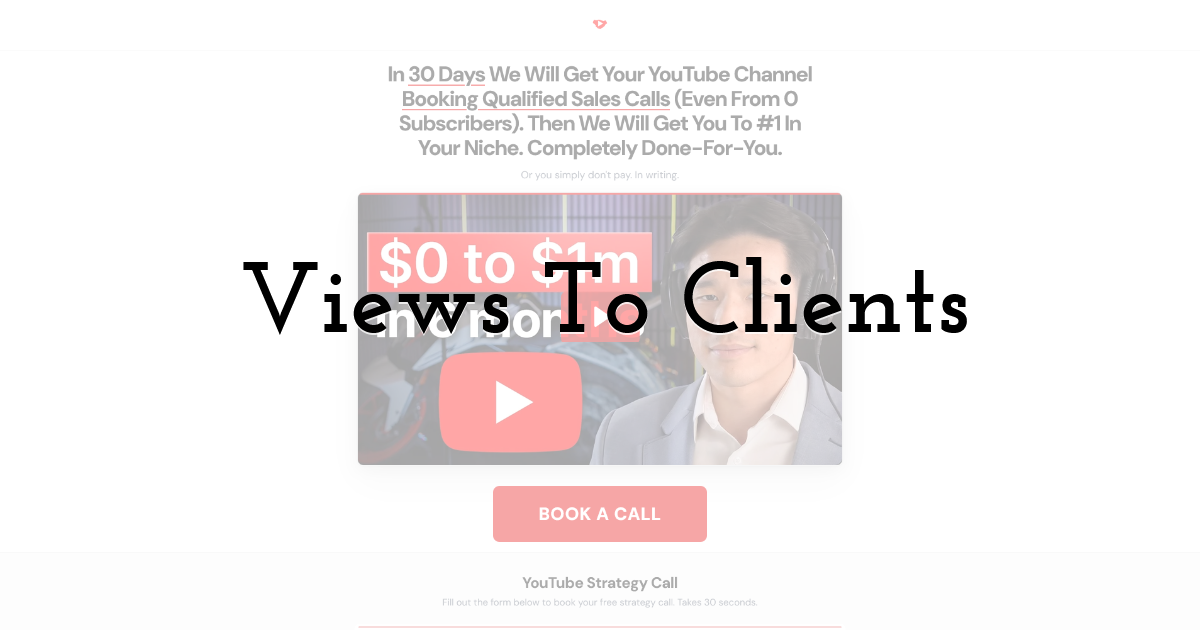
Views To Clients, run by Jake Trinder out of Newcastle (UK), takes a radically different approach to SaaS video: they produce YouTube content engineered to generate sales calls and closed deals, not brand awareness. Their pricing model is results-based, meaning if they do not deliver, you do not pay. In writing.
The production cadence is one video per week. The client shows up, records, and VTC handles everything else: research, scripting, editing, upload, and optimization. Expect initial traction within 30 to 60 days and meaningful momentum in three to six months.
A proprietary AI research system drives their content strategy. It analyzes title formats, thumbnail styles, video structures, and emerging topics across YouTube to identify what will perform before a single frame is shot. This data-driven foundation replaces the guesswork that plagues most YouTube strategies.
Client results are striking:
- • Over $1 million in direct sales from YouTube within 12 months, with projections approaching eight figures
- • 700,000+ views and 16,000+ subscribers within 60 days for one client
- • Multiple closed deals attributed directly to YouTube content where a previous agency had failed
Trustpilot confirms the pattern with a perfect 5/5 rating. Clients describe the difference versus prior agencies as "night and day."
This is not a motion design agency in the traditional sense. You will not get animated explainers or product walkthroughs. What you get is a revenue-generating YouTube machine that turns founder expertise into inbound pipeline. For SaaS companies where the founder's face and voice are the brand, VTC delivers an ROI model that most agencies cannot touch.
9. Solvis Media
Solvis Media produces testimonial videos across all 50 US states, covering everything from budget-friendly UGC-style clips to cinema-grade corporate productions. Their nationwide crew network means they can shoot in any major, mid-major, or small market city without flying a team cross-country.
Their "new-wave" approach distinguishes them from the talking-head default. Instead of a single person at a desk, Solvis builds testimonials with storytelling arcs, multiple interviews, on-site B-roll, and professional set design. The result: higher viewer retention and stronger emotional impact than conventional testimonial formats.
Reported client outcomes are substantial. An average 157% increase in web traffic. Up to twice as many leads generated. A 20% conversion lift from lead to sale within the first months of deployment. They also cite third-party data: 77% of people who watch a brand testimonial video say it influenced their purchase decision, and landing pages with video testimonials see up to an 80% conversion increase.
For SaaS companies specifically, Solvis positions testimonial video as a sales cycle accelerator. Real users demonstrating how your CRM or financial platform solved a concrete problem reduces skepticism faster than any animated explainer. Their team handles the full production arc from concept to distribution strategy, including guidance on where and how to deploy each video for maximum conversion impact.
The experience range spans startups through Fortune 500 accounts, giving them the flexibility to match production scope to budget. Pricing varies by location, set design, talent fees, and deliverable count, but they explicitly market affordable options alongside their premium tier.
10. Outmost Studio
UK-based Outmost Studio prices its SaaS explainer videos between £10,000 and £25,000+, depending on length, animation style (2D versus 3D), and creative complexity. Standard production runs four to six weeks from concept to final delivery, while end-to-end projects including discovery stretch to six to ten weeks. Rush timelines are available.
The agency offers unlimited revisions at each production stage, a policy that most competitors restrict or charge extra for. Their collaborative workflow runs through a dedicated feedback platform where clients track versions, leave comments, and approve milestones with full transparency on deadlines.
Their portfolio includes a standout result: a video that screened at Davos and contributed to a $350 million fundraise. Client feedback describes the process as "a pleasure" and the output as "very impressive," with particular praise for how the team structures complex concepts into clear, conversion-focused narratives.
Beyond explainers, Outmost produces brand stories, commercials, social ads optimized for silent autoplay, animated infographics, and PR campaign content. Their multilingual capabilities cover script translation, voiceover sampling, and video retiming to match the pacing of target languages, including checks for cultural colloquialisms.
The in-house team manages scripting and storyboarding from scratch. They distill the client's core message into a narrative centered on the audience's primary pain point, then build the visual treatment around it. That conversion-oriented methodology is what separates specialist SaaS studios from generalist animation houses that prioritize aesthetics over commercial outcomes.
11. Thrive Internet Marketing Agency
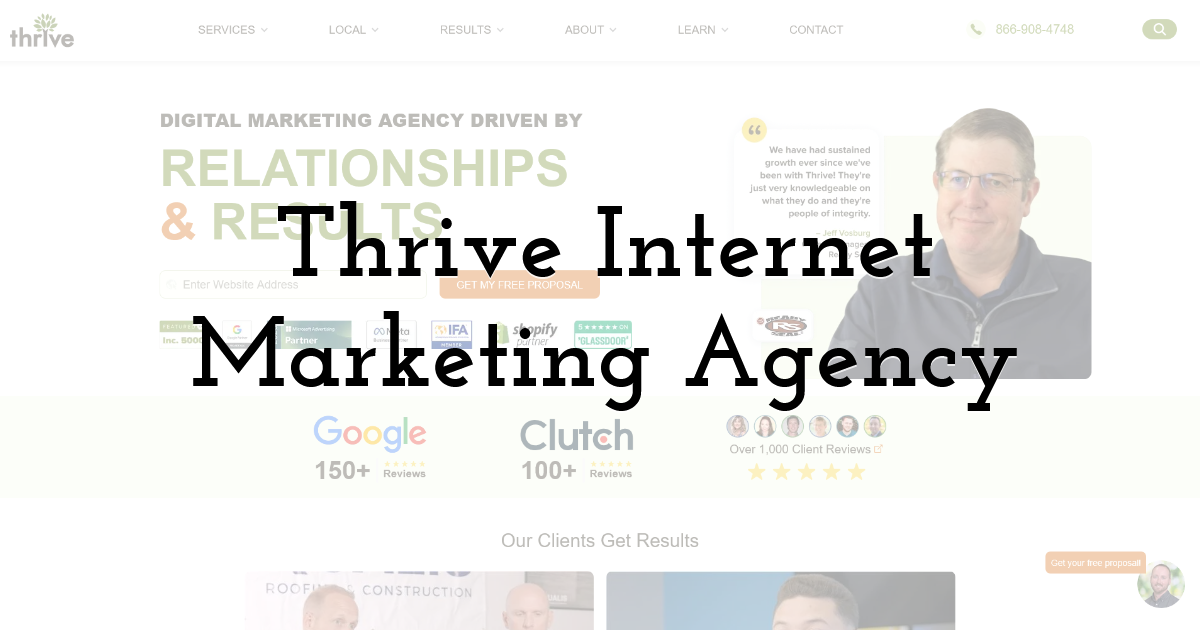
Thrive Internet Marketing Agency, headquartered in Arlington, Texas, combines video testimonial production with broader digital marketing services. Founded by Matt Bowman, the agency serves clients across the United States, Canada, and the United Kingdom from their 4604 Park Springs Blvd office.
Their testimonial process is methodical. It begins with discovery and planning, moves through client selection (identifying your best advocates), then into pre-production where the team prepares story arcs and key talking points. Production includes professional on-site or remote interviews with B-roll capture. Post-production refines the footage, enhances audio and visuals, and adds graphics and music. Each testimonial includes two revision rounds before final delivery.
What sets Thrive apart is their marketing integration layer. They do not just hand you a finished video. The team advises on distribution, helps integrate testimonials into existing campaigns, and optimizes content for specific channel requirements. That holistic approach reflects their roots as a full-service digital marketing agency rather than a standalone production house.
The agency cites data showing testimonial advertising can boost conversion rates by up to 32%. Paired with their drone footage, product photography, and customer story video services, they offer a versatile media toolkit for SaaS companies that need more than just animated content.
Client reviews consistently score 5 out of 5, with praise for attentiveness and the team's ability to guide companies with limited marketing experience. The tradeoff mirrors D-MAK: this is a testimonial and live-action specialist, not a motion graphics studio. SaaS teams needing animated explainers should pair Thrive's testimonial work with a dedicated animation partner from elsewhere on this list.
FAQ
How much does a SaaS motion design video typically cost?
Pricing varies dramatically based on style, length, and agency tier. Simple AI-generated explainers cost very little (or nothing with tools like Opus), while basic animated videos from specialized agencies start around £1,200 or $5,000.
Premium productions with custom 3D animation, professional voiceover, and multi-format deliverables can reach $25,000 to $40,000 or more. Subscription models from agencies like Motion The Agency or Superside offer a different cost structure entirely, bundling ongoing creative output into a monthly fee.
What should I look for when choosing a motion design agency for my SaaS product?
Prioritize agencies with proven SaaS experience over generalist animation studios. Check whether they understand product messaging frameworks like problem-agitate-solve and whether their portfolio shows actual conversion metrics, not just pretty visuals.
Evaluate their production process for collaboration touchpoints, revision policies, and deliverable formats. A studio that hands off developer-ready files (Lottie, JSON, After Effects sources) saves your engineering team hours of implementation work compared to one that delivers only a final MP4.
How long does it take to produce a SaaS explainer video?
Most agencies deliver a finished explainer video in four to six weeks under standard conditions. Faster studios like Masterly can complete UI animations in one to two weeks, while complex projects with discovery phases stretch to ten weeks or longer.
AI tools like Opus generate videos in minutes rather than weeks, but the output suits high-volume content needs more than flagship launch assets. Always confirm whether the quoted timeline includes scripting and storyboarding or only the animation phase.
Should I choose an animated explainer or a live-action testimonial video?
Each format serves a different funnel stage. Animated explainers work best for top-of-funnel awareness, product education, and landing page conversion where you need to simplify complex features visually.
Live-action testimonials excel at building buyer trust during mid-to-late funnel stages. Real customers describing concrete outcomes reduce purchase skepticism faster than animation. Many SaaS companies deploy both, using animated videos for acquisition and testimonials for closing.
Can I use a subscription model instead of paying per video?
Several agencies on this list offer subscription-based pricing. Motion The Agency provides a monthly plan with a dedicated team and project manager. Superside operates entirely on a flexible subscription that scales hours up or down each month.
The subscription approach makes sense for SaaS companies producing content at volume across product launches, feature updates, social campaigns, and sales enablement. Per-video pricing remains more cost-effective for companies that need just one or two videos per year for specific campaigns.
Until next time, Be creative! - Pix'sTory
Recommended posts
-

5 Design Side-Hustles that Can Boost Your Income
Read More › -
Minimalism in App Design: How Does it Boost User Experience
Read More › -
8 Ways to Improve Your Website Performance
Read More › -

Most Common Photo Editing Mistakes to Avoid
Read More › -

The Best SEO Software for Agencies in 2026, Judged by the Jobs It Has to...
Read More › -
11 Unique Ways to Use Instagram Guides for Marketing
Read More ›