Payment Orchestration Platform Features Worth Paying For
Every failed payment has a price. Not just the lost transaction – there's the customer who abandons the cart, the support ticket that follows, and the churn that compounds quietly over months. Businesses processing a serious volume have found a clear answer to this problem: a well-built payment orchestration platform.
The market reflects that shift. The payment orchestration platform market is growing rapidly – from $3.06 billion in 2025 to $3.66 billion in 2026 at a CAGR of 19.6%, according to Research and Markets. That's not speculative momentum. It's businesses voting with their budgets.
Not every feature on a vendor's pitch deck deserves equal attention, though. Some drive measurable revenue impact. Others look impressive and do little. Here's what actually matters.
What a Payment Orchestration Platform Does
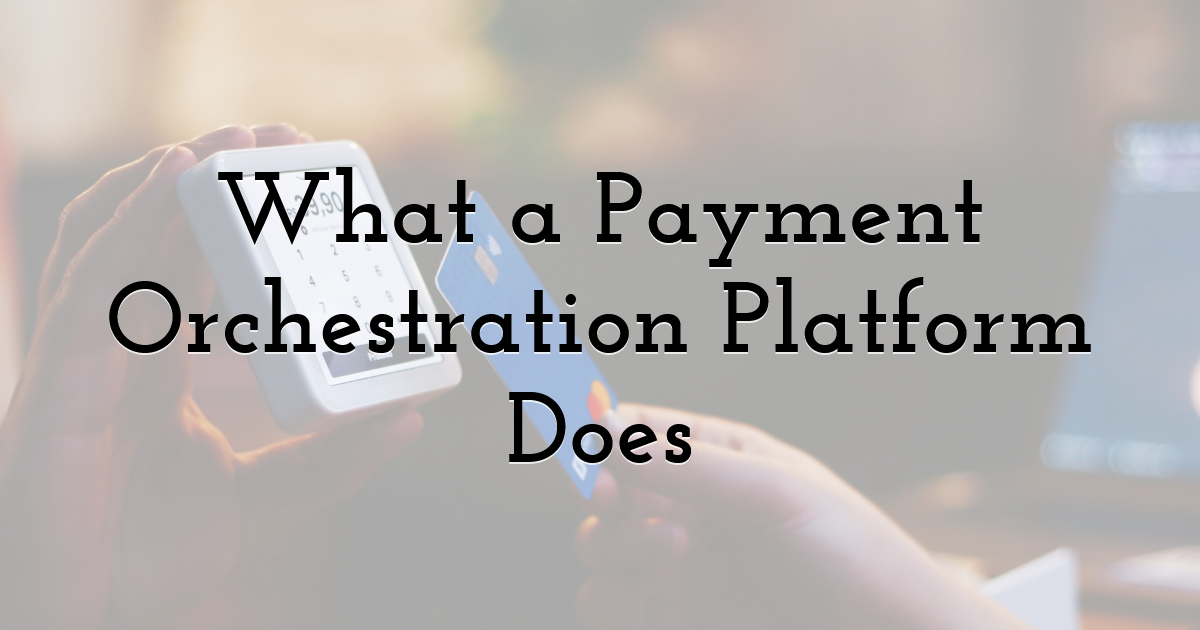
At its core, a top payment orchestration platform acts as an intelligent middleware layer between a business and every payment provider it uses. Instead of connecting directly to a single processor, it routes each transaction to the right provider at the right moment – while centralizing data, fraud controls, and reporting in one place.
For businesses operating across multiple countries or running subscription billing, that layer isn't optional. It's what keeps a complex payment stack manageable. Whop’s payment orchestration is built for those stacks: it routes each charge across partner processors and cascades on declines, so multi-country and subscription businesses are not locked to a single PSP.
Features That Directly Affect Revenue
The revenue impact of orchestration comes from a specific set of capabilities – not the platform as a whole, but the mechanics underneath.
Smart Routing: The Core Engine
Smart routing evaluates each transaction – card type, issuing country, currency, historical approval rates – and sends it to the processor most likely to approve it. This happens in milliseconds, before the customer sees anything.
The results are documented. Platforms combining intelligent routing with tokenization have shown a 23% improvement in transaction approval rates. Merchants typically see a 2–4% authorization lift immediately after implementing orchestration, with 5–10% improvement as routing logic matures over time.
Multi-PSP and APM Connectivity
Connecting to payment service providers one by one means separate integrations, separate contracts, and engineering work every time a new market or method is needed. A payment orchestration platform replaces that with a single integration covering dozens of PSPs and local alternative payment methods:
- • Bank transfers: iDEAL (Netherlands), Pix (Brazil), BLIK (Poland)
- • Digital wallets: Apple Pay, Google Pay, regional equivalents
- • BNPL providers: increasingly standard across retail and subscription verticals
Beyond coverage, multi-PSP connectivity changes fee negotiations. When switching processors is a configuration change rather than a six-month project, provider lock-in loses most of its power.
Features That Protect and Streamline Operations
Revenue features get the attention. But the operational capabilities of a payment orchestration platform are what prevent that revenue from leaking out the other side.
Agnostic Tokenization: What It Means for Stored Cards
Most processors use proprietary token formats. Switch providers and stored customer cards become unusable – a serious problem for any subscription business. Agnostic tokenization stores credentials in a neutral vault that any connected processor can read.
A returning customer's saved card works regardless of which acquirer handles the transaction. That continuity is especially valuable where repeat billing drives revenue. It also reduces PCI DSS compliance scope, since sensitive data lives in one secured environment rather than spread across multiple provider systems.
Unified Fraud Management Across Channels
Fraud tools – 3DS authentication, risk scoring, device fingerprinting, chargeback tooling – rarely come from a single vendor. Without orchestration, each is integrated per gateway, creating gaps and inconsistencies across payment channels.
A payment orchestration platform centralizes those controls so that rules and authentication protocols apply uniformly. This matters practically: Strong Customer Authentication (SCA) under PSD2 is far easier to enforce consistently through one hub than across fragmented per-processor setups.
Automated Reconciliation and Centralized Reporting
Finance teams managing multiple processors know the problem: settlement reports arrive in different formats, on different timelines, from separate portals. Reconciliation becomes a manual exercise that tells you what happened days after the fact.
Centralized analytics pulls every data stream into one dashboard – approval rates, fee comparisons, decline clustering – in real time. Automated reconciliation then matches processed transactions against bank settlements without manual input.
The outcome: fewer accounting errors, faster close cycles, and payment data that's actually actionable rather than retrospective.
Feature Comparison at a Glance
| Feature | Primary Benefit | Most Relevant For |
|---|---|---|
| Smart Routing + Cascading | Higher approval rates | High-volume and global merchants |
| Multi-PSP / APM Connectivity | Local payment coverage, fee flexibility | Cross-border businesses |
| Agnostic Tokenization | Local payment coverage, fee flexibility | Cross-border businesses |
| Unified Fraud Management | Consistent detection, SCA compliance | Regulated markets, high-chargeback sectors |
| Automated Reconciliation | Accurate books, reduced manual work | Multi-gateway finance teams |
When Does the Investment Actually Make Sense?

Not every business needs a payment orchestration platform. A single-market merchant with low volume and a straightforward checkout usually gets more value from a direct PSP integration. The calculus shifts when:
- • Transaction volume is high enough that approval rate improvements generate measurable revenue
- • The business operates in multiple countries where local methods and acquirer relationships affect conversion
- • Engineering bandwidth is limited and connecting new payment methods one by one is slowing product development
At sufficient scale, documented cases show platform costs fully recovered within three months of implementation.
Frequently Asked Questions
What is a payment orchestration platform?
A payment orchestration platform is middleware that connects a business to multiple payment processors, gateways, and alternative payment methods through a single integration – handling routing, fraud management, tokenization, and reporting from one place.
How does smart routing improve approval rates?
Smart routing analyzes transaction attributes in real time and directs each payment to the processor with the highest historical success rate for that specific combination of card type, country, and currency. If the first processor declines, cascade logic retries via a backup automatically.
Is a payment orchestration platform only for large businesses?
Not strictly – but the ROI is strongest at higher volumes. Businesses processing millions in monthly transactions see the clearest return, since even small approval rate improvements translate to significant recovered revenue at scale.
What's the difference between a PSP and a payment orchestration platform?
A PSP processes payments. A payment orchestration platform manages multiple PSPs – deciding which one handles each transaction, consolidating their data, and applying fraud and tokenization rules across all of them simultaneously.
Does using an orchestration platform reduce PCI DSS compliance burden?
Yes. Agnostic tokenization stores sensitive card data in a single secured vault rather than across multiple provider environments, which narrows the PCI DSS compliance scope significantly for most businesses.
Until next time, Be creative! - Pix'sTory
Recommended posts
-
The Complete Guide to Launching a Mobile Business: Branding, Tools, and S...
Read More › -
Increase Social Media Engagement with Professional Photo Editing for Smal...
Read More › -
How Visual Communication Can Sell Digital Payment Solutions
Read More › -
Payment Orchestration Platform Features Worth Paying For
Read More › -

The Art of Presentation: Selling Your Business Visually
Read More › -
8 Best Virtual Assistant Platforms for Entrepreneurs and Solopreneurs
Read More ›