The Complete Guide to Launching a Mobile Business: Branding, Tools, and Setup Costs
The mobile business model has moved from niche experiment to mainstream strategy. Coffee vans, mobile salons, pop-up retail units, and traveling consultants are turning up in every market - because the overhead is lower, the reach is wider, and modern customers increasingly expect services to come to them.
But launching a mobile business involves more than buying a vehicle and hitting the road. There's a brand to build, a workspace to configure, tools to source, and a cost structure to understand before any of it makes sense financially. This guide covers all of it.
Defining Your Mobile Business Model

Before spending anything, it's worth being precise about what kind of mobile business you're actually building. The setup costs, tools, and branding requirements vary significantly depending on your model. Each type has different demands on space, power, and customer-facing presentation - and defining yours upfront shapes every other decision in the launch process.
The three most common models break down like this:
| Model | Primary Use | Key Requirements |
|---|---|---|
| Mobile service | Traveling workspace (grooming, beauty, IT, therapy) | Equipment storage, power, climate control |
| Mobile retail / pop-up | Customer-facing interior, product display | Display fixtures, payment systems, lighting |
| Mobile office / outreach | Consultation, healthcare, nonprofit services | Connectivity, professional interior, specialized equipment |
A mobile retail setup will have completely different build priorities than a mobile office van. Getting clear on your model before choosing a vehicle - or commissioning a conversion - prevents expensive mid-build changes.
Building a Brand Identity That Travels With You

A mobile business lives in public. Every time you park, you're putting your brand in front of potential customers. That makes visual identity more critical here than it is for most brick-and-mortar operations, where the storefront does the heavy lifting.
Research consistently shows that consistent brand presentation across platforms can boost revenue by up to 23% - a number that gets even more significant when your primary marketing channel is the vehicle itself.
Start with the core assets before anything else:
- • Logo - must work at multiple scales, from business card to van wrap
- • Color palette - 2-3 primary colors, consistently applied across all materials
- • Typography - one heading font, one body font; legibility at distance matters for signage
- • Tone of voice - how you write on social, in person, and on printed materials
Locking these down before you commission a wrap or print any collateral saves significant rework cost later. A logo that looks clean on a phone screen but falls apart at large scale is going to cause problems when it's time to brand the vehicle.
One underrated aspect of mobile business branding is the story behind the operation. Because mobile businesses are inherently visible and personal, customers connect with the human side more readily than they do with a fixed storefront.
The Vehicle Setup: Your Most Important Investment
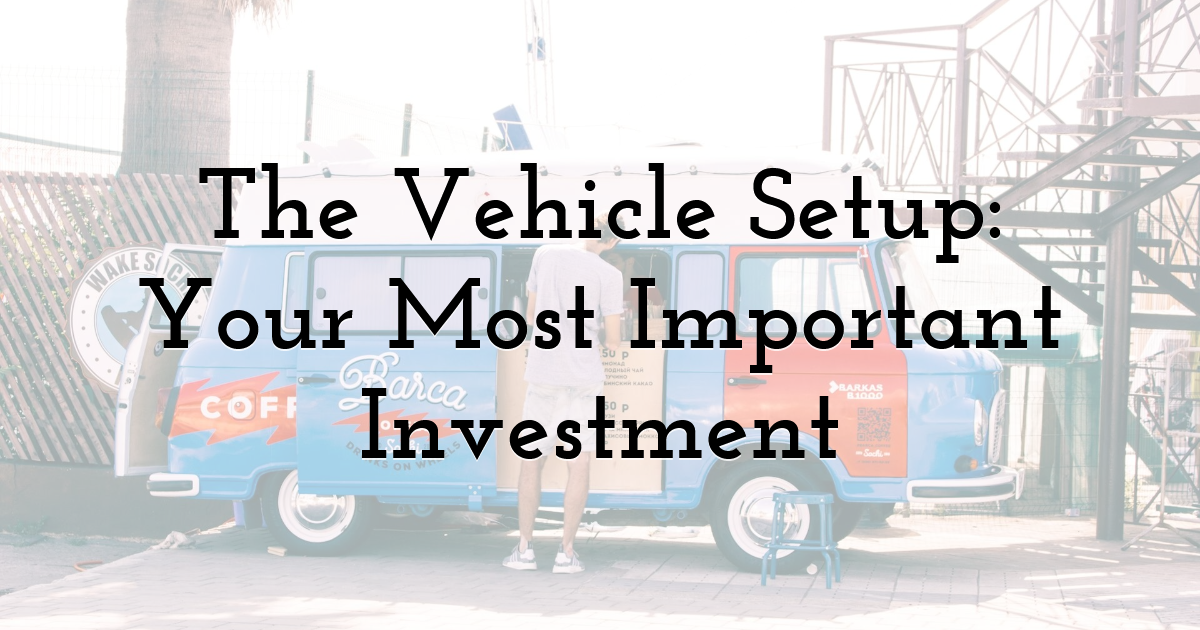
The vehicle isn't just transport - it's your workspace, storefront, and brand ambassador all in one. Getting the setup right has a direct impact on how efficiently you can operate and how professionally you present to customers.
For most mobile businesses, a full-size commercial van is the standard starting point. Ford Transit, Mercedes Sprinter, and Ram ProMaster are the most common base vehicles. The right choice depends on what the interior needs to contain, not on preference alone - roof height, wheelbase, and payload rating all matter.
The conversion is where costs diverge most sharply. Understanding what different build levels actually involve - and what a complete van conversion for a mobile business looks like at various price points - is worth researching carefully before committing to a spec. Here's a rough breakdown of what to expect:
| Build Level | Typical Cost | What's Included |
|---|---|---|
| Basic fit-out | $5,000 - $10,000 | Shelving, storage, basic electrical |
| Mid-range professional | $20,000 - $40,000 | Climate control, power system, custom cabinetry |
| Fully equipped specialist | $50,000+ | Plumbing, satellite connectivity, specialized equipment |
A reliable power system is non-negotiable regardless of build level. Depending on your equipment needs, budget for a shore power hookup option, an onboard battery bank, or both. Solar panels are increasingly viable for operations that spend extended time parked. Climate control matters too - a workspace that becomes unusable in extreme heat or cold is a business continuity problem, not just a comfort issue.
Essential Tools and Tech for Operating on the Move
Running a business from a vehicle means solving for connectivity, software, and operational logistics simultaneously.
Connectivity: A 4G/5G mobile router is the baseline. For operations that depend on high-bandwidth tasks - video calls, cloud backups, point-of-sale systems - a Starlink or similar satellite setup is worth considering, particularly for businesses operating outside urban areas.
Business operations software: Most mobile businesses can run lean here. A solid invoicing and bookkeeping tool (QuickBooks, Wave, or FreshBooks), a scheduling system (Acuity, Calendly, or Square Appointments), and a mobile payment processor cover the core operational needs. Add a CRM if you're managing a repeat client base.
Marketing and design tools: Social media presence matters more for mobile businesses than most, because your location changes constantly. Posting consistently about where you are and what's available drives foot traffic and repeat visits. Having access to design tools for creating promotional visuals means you can produce location-specific posts and offers quickly without outsourcing every asset. PixTeller's flyer maker is a practical option for building those materials in-house, with enough template flexibility to stay consistent with your existing brand system.
Navigation and logistics: Google Maps covers basic routing, but businesses with multiple daily stops benefit from route optimization tools like Circuit or OptimoRoute. Reducing unnecessary drive time adds up fast when fuel is a significant operating cost.
What Does It Actually Cost to Launch?
The SBA's startup cost framework breaks new business expenses into one-time assets and recurring costs. For mobile businesses, the biggest one-time asset is almost always the vehicle and conversion. Here's a realistic cost picture across the main categories:
| Cost Category | Low End | High End | Notes |
|---|---|---|---|
| New commercial van | $35,000 | $55,000 | Ford Transit, Sprinter, ProMaster |
| Used commercial van | $15,000 | $25,000 | More maintenance risk on older units |
| Conversion and fit-out | $8,000 | $50,000+ | Depends heavily on build spec |
| Vehicle wrap | $2,500 | $5,000 | Single highest-ROI branding investment |
| Website and collateral | $500 | $3,000 | Depends on complexity |
| Operating reserve (3-6 months) | $10,000 | $25,000+ | Fuel, insurance, maintenance, supplies |
One cost-reduction lever worth knowing: commercial vans used for business qualify for Section 179 accelerated depreciation under U.S. tax rules. According to IRS Publication 946, heavy commercial vehicles (GVWR over 6,000 lbs) with no passenger-use limitation can qualify for significant first-year deductions, which meaningfully reduces the effective purchase cost. Talk to your accountant before buying to structure the acquisition correctly.
A realistic all-in launch budget for a professionally equipped mobile service business runs somewhere between $50,000 and $100,000. That figure looks very different when compared to the cost of securing and fitting out a commercial lease in most cities, which in competitive markets runs higher and carries far more locked-in commitment.
Marketing Your Mobile Business
The advantage mobile businesses have is built-in visibility - but only if you use it deliberately. A well-branded van parked in a high-traffic location does passive marketing around the clock. It's your single highest-ROI branding investment because it works continuously without additional spend.
Beyond passive visibility, consistent active marketing depends on a few straightforward habits:
- • Announce stops in advance on Instagram and local community groups
- • Post behind-the-scenes content from setup and service to build familiarity
- • Build relationships with neighborhood associations, markets, and event organizers
- • Set up Google Business Profile early - even though your location changes, strong reviews and regular updates build local search credibility over time
For offline marketing, well-designed physical materials - flyers, postcards, signage - distributed near regular stop locations build local name recognition quickly. The key is keeping everything on-brand so each touchpoint reinforces the same visual identity your vehicle is already communicating.
Final Thoughts:
Launching a mobile business means getting several things right at once: a clear model, a strong visual identity, a properly configured vehicle, and a realistic picture of costs. None of it is complicated, but each piece has enough detail to become expensive if it's treated as an afterthought. Get the brand and build right from the start, and the mobile model rewards you with flexibility and reach that a fixed location can't easily match.
Until next time, Be creative! - Pix'sTory
Recommended posts
-

Managing Your Business' Payment Processes More Effectively
Read More › -

The Art of Presentation: Selling Your Business Visually
Read More › -
The Complete Guide to Launching a Mobile Business: Branding, Tools, and S...
Read More › -

How IoT and SaaS Startups Should Visually Pitch a Connected Product
Read More › -
Increase Social Media Engagement with Professional Photo Editing for Smal...
Read More › -
Payment Orchestration Platform Features Worth Paying For
Read More ›