How Web Design Affects Your SEO Performance
Ask a layman about SEO, and maybe they’ll be able to tell you that it has something to do with keywords. If they’re a bit more “in the know,” they’ll mention things like backlinks and meta tags, too. And they’ll be right, of course, but those things don’t even begin to tell the whole story.
If your website looks dated, loads slowly, or is hard to use, search engines will quietly punish you for it. They won’t do this because they particularly like pretty sites, but because your design pushes users away, and a search engine’s whole purpose, at least in theory, is to present the overall best results for a particular query.
In practice, this means that your layout, navigation, fonts, colors, images, and code all shape how people behave on your site. Modern search engines read that behavior as a set of signals that influence how high (or low) you show up in the results.
Your website, then, is the foundation of your entire marketing engine, and design is the part visitors experience first.
Why Web Design and SEO Are Inseparable
Consumers now research almost everything online before they buy. One recent review notes that people rely heavily on a business’s website when evaluating credibility and value long before they ever talk to a human.
If your design makes that research painful with hard-to-read text and clumsy navigation, visitors will simply back out and go to a competitor. The supply is abundant, so why wouldn’t they? Search engines see that fast return to the results page and interpret it as your page not satisfying the user, which must mean that it’s not very good.
In other words, your search visibility depends on whether people enjoy using your site enough to stay, click, scroll, and come back.
Signals Search Engines Notice
The inconvenient truth is that people don’t give your site much time to make its case. Stanford’s Web Credibility Project found that nearly half of users (46.1%) base their judgment of a site’s credibility in part on its visual design. If that feels cheap or outdated, they assume the business behind it is, too.
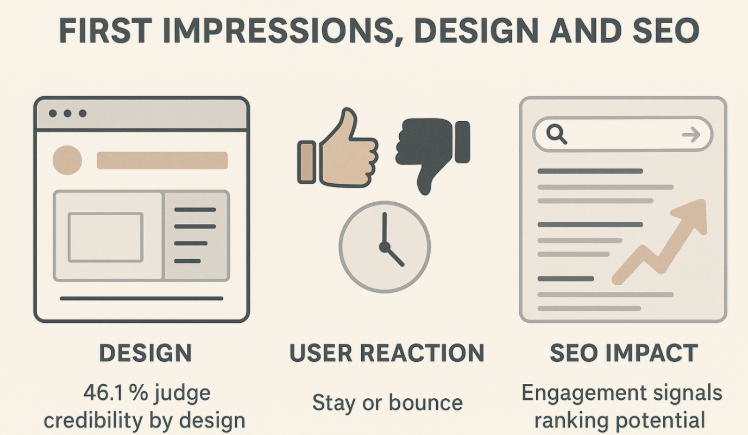
That gut reaction obviously hurts sales, but it also affects how long people stay on a page and whether they explore other pages of your site.
We now know that those are exactly the kinds of behaviors that search engines want to encourage, which means you need to align your website with the way humans decide whom to trust, feeding the right behavior signals, and supporting stronger rankings over time.
Invisible Design Layer
Design is not just about looking pretty, either. In fact, you could argue that most of it happens under the hood, defining how fast your layout loads, how stable it is as content appears, and how quickly people can interact.
Google’s own research on mobile behavior found that over half of mobile site visits are abandoned if a page takes longer than three seconds to load.
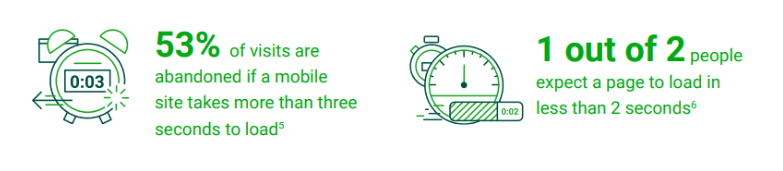
That brutal cut-off means that although you might have the perfect content, a sluggish layout could turn most users away before they ever see it.
Here are the three things that connect SEO with design in this context:
Mobile-first layouts
Most traffic now comes from phones, and Google indexes your mobile version first. That means you need responsive grids and thumb-friendly buttons and navigation. If your hero image, fonts, or carousels look great on a desktop but turn into a zoom-and-scroll nightmare on mobile, your rankings will reflect it over time.
Page speed
Large uncompressed images and videos, and “fancy” scripts can be pretty, but they add weight to your page. This prolongs loading times, driving users away, so to prevent it, you need to make some speed-focused decisions, like:
- • Using modern image formats (WebP/AVIF) and proper compression
- • Avoiding heavy sliders and auto-play media where they don’t add real value
- • Designing layouts that work with fewer external scripts and plugins
Core Web Vitals
Google’s Core Web Vitals (Largest Contentful Paint (LCP), Cumulative Layout Shift (CLS), and interaction metrics) are now part of the ranking equation and measure how quickly your page loads and how stable the layout is, among other important factors.
Good design boosts those metrics by making sure that above-the-fold content appears quickly and keeping interactive elements simple and fast to respond.
Information Architecture

Another place where SEO and design intersect is your site architecture. Clear, logical navigation makes it easy for users to find what they need, and it gives search engines strong clues about which pages matter most and how topics relate to one another.
Academic work on web credibility highlights information structure and loading speed as key factors in how people judge online information. When those factors are handled well, visitors trust the site more and move through it more confidently, again generating the kind of engaged sessions that search engines like to see.
Content Layout and On-Page Design
Stanford’s guidelines for web credibility specifically call out professional visual design and ease of use as core ingredients in building trust. In other words, you can have the best article on the internet and still lose if the layout makes it hard to read, while a well-structured page naturally encourages visitors to scroll, skim subheadings, and interact with elements like FAQs or calls to action.
Assume visitors will skim your subheadings and images before they commit to reading, and make sure those elements alone tell a clear story.
Calls to action should feel like the next obvious step after the content they follow, and design can reinforce that by placing CTAs in context-rich areas and avoiding aggressive pop-ups that break the flow.
The biggest risk with any redesign is only treating it as a visual refresh when it’s arguably a performance project above all else. So, to keep SEO front and center, approach your next design update as a joint effort between designers, developers, and SEO specialists.
If you treat web design as part of your SEO toolkit, you’ll make smarter decisions about layouts, media, navigation, and performance. That, in turn, gives both visitors and search engines more reasons to choose your site over the alternatives.
Until next time, Be creative! - Pix'sTory
Recommended posts
-

How to Start a Photography Business With No Experience - The Ultimate Gui...
Read More › -

4 Benefits of Video in Your Digital Marketing Strategy
Read More › -

5 Best Advantages of Using Social Media Automation Tools for Businesses
Read More › -
Best Practices for Crafting Effective Call-to-Action Buttons in Emails
Read More › -

8 Things to Include in Your Website Upgrade
Read More › -
How Graphic Design Plays an Important Role in Social Media Marketing
Read More ›