The Emergence of Lightweight Video Editing for Average Joes
In the good old times, video production required certain talent and special equipment. Nowadays it has become an essential part of daily communication. Some person films the start of selling a new cake in the bakery via his/her cell phone. Another person creates an impromptu training session during a break between his classes. There is someone who transforms the footage captured by the computer camera into a short guide. And then there is the businessman sitting behind his desk and explaining the latest updates regarding the company's product line. They may not consider themselves video editors, but now video editing has become an integral part of their work.
And this is where the significance of lightweight editing lies. In the cases when one has to cut something, combine several clips, add some music, re-size a video for social networks, or make a branded video right away, using a simple video maker tool is a far more reasonable option. And the main thing here is to finish everything quickly without making out of it.
Why editing became part of everyday work
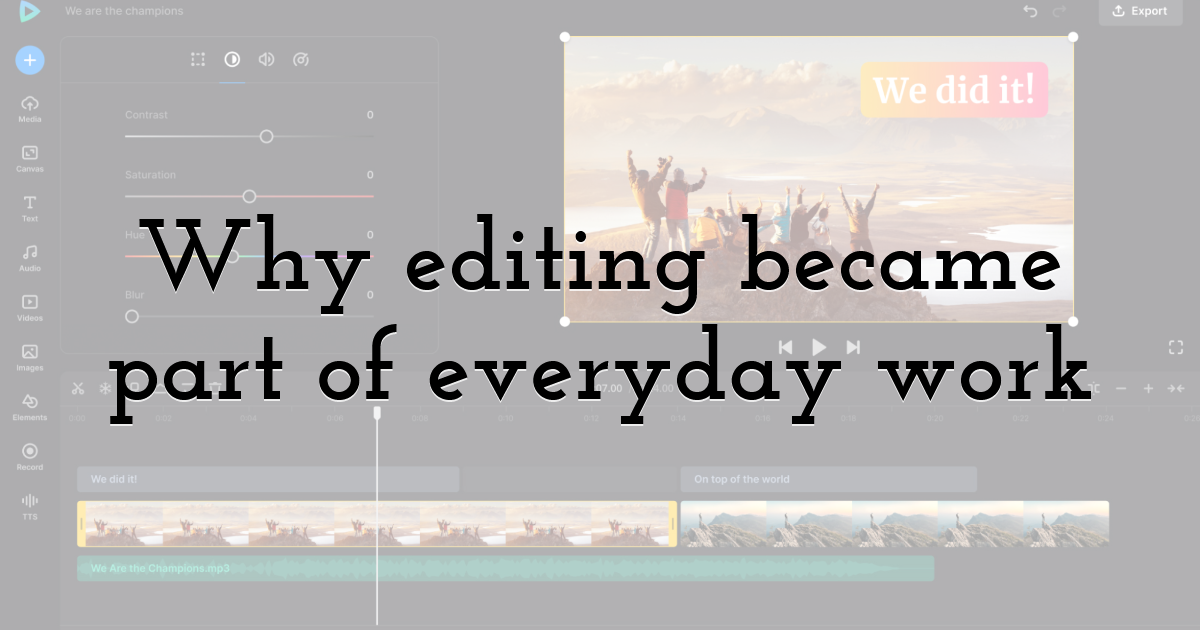
The most significant transformation isn’t just technological in nature. High quality videos are being taken by smartphones; and there are plenty of filmmakers who can create a good frame. The real difference is more behavioral – people now demand that any business or educator, or content creator for that matter, communicate through visuals. A written blog post will do, but the message comes across clearer in video form.
For everyday creators, video is used in small practical moments:
- • showing how a product works;
- • answering a common customer question;
- • turning a blog idea into a short clip;
- • making a behind-the-scenes post;
- • preparing a tutorial for a course or newsletter;
- • recording a quick announcement;
- • repurposing webinar fragments into social media videos.
This type of content rarely needs a full editing timeline with dozens of layers. It needs clarity. It requires having a good introduction, a proper body, and a good conclusion. It should consist of easily readable texts, well-balanced audio and formatting that suits the specific platform. That is the space where lightweight video editing has grown so quickly.
The use of professional video hasn’t lost relevance either, particularly for video campaigns, product launches, and branding projects. Everyday content works differently. It is faster, more frequent, and more practical. A creator may need five short edits in one afternoon, not one perfect video after three weeks.
The phone became the first studio
Mobile videography revolutionized the process of video production by virtue of the presence of a camera on the device itself. An individual can make a video demo, record an interview, shoot an event, or just a plain head shot without having to go through the trouble of renting a studio. Here’s a helpful guide to making professional videos using an iPhone from Wistia. And the most important tip from their post is the following one – high quality usually begins with small things, such as stable shots, good lighting, and clean audio.
Lightweight video editing seamlessly flows from mobile shooting since a person creates his/her video via a smartphone. The workflow is short because the content itself is short.
This has also changed what “good enough” means. Viewers do not expect every educational reel, small business update, or quick tutorial to look like a commercial. They expect it to be clear and watchable. A slightly imperfect clip with useful information can perform better than a polished video that takes too long to publish.
Still, simple does not mean carelessness. The strongest everyday videos usually have a few common qualities:
- • the first seconds explain why the viewer should keep watching;
- • the frame is steady enough to feel intentional;
- • the message fits one idea;
- • captions help people watch without sound;
- • the ending gives the viewer a next step.
These details are small, but they separate a rough upload from a piece of content that feels ready.
The new editing habit is modular
Lightweight video editing is not just about using easier software. It is about working in modules. As opposed to looking at content creation as one large project, people use smaller building blocks that consist of elements such as an intro shot, main video clip, text overlay, music, logo, and call-to-action button before exporting everything as one whole project.
That way, a single recording can be converted into a number of different types of projects. For example, a horizontal tutorial video can be transformed into a vertical version or a product video can be posted both in horizontal and square format. Similarly, an inquiry from a customer can be used in the making of a reel, story, or even embedded on a website.
The most useful lightweight editing tools remove friction from these repeatable tasks. A creator should not have to rebuild the same layout every time. The faster the technical part becomes, the more energy remains for the message.
This is also why online video editor platforms became popular among non-specialists. They lower the pressure around editing. There is no need to install a large program, manage complicated project files, or understand every technical setting before making something useful. The editing process becomes closer to writing a post or designing a simple graphic.
Even HubSpot’s guide on video marketing on a budget follows the trend. All people adore video marketing techniques; however, not all of them are able to implement it without transforming it into something extremely expensive. In particular, for small firms, the opportunity to make videos through the Internet can make a huge difference.
Where lightweight editing works best
Lightweight editing is strongest when the goal is speed, clarity, and distribution. It works especially well for formats where the message is more important than complex visual effects.
Product explainers are a good example. All that is needed is to show your product, to highlight its specific qualities, to post a caption under it and to call to take some actions. Instructional videos operate the same principle. A teacher, coach, or consultant can record one idea and shape it into a polished minute-long video.
It also works well for creators who build trust through consistency. A person who posts useful clips every week usually needs a process that is sustainable. Heavy editing can make content feel too demanding. Lightweight editing helps keep the rhythm alive.
There are also less obvious uses. Corporate video can be one example of such a video that requires no involvement of a special department responsible for video content creation. In addition to being informative, a two-minute video could serve as a more convenient way of delivering information than an extensive email.
When it comes to bloggers or owners of different websites, there is always another way of using lightweight editing: converting already created content into video content. You can take a listicle and transform it into an instructional video, a product review into a narrated clip, and even how-to articles into video guides with captions. All of that seems quite obvious as the main ideas have already been written.
What Everyday Creators Should Consider
The greatest error made by amateur video editors is using editing as a means of beautifying their videos. Even though effects, filters, music, and transitions might be useful in some way, they are unlikely to help solve problems that stem from a vague concept. The perfect light video starts with a very simple question: what should the viewers take away from the video?
After settling on the question, editing becomes easy. Remove any distractions, use the most powerful image at the start of the video, caption where necessary, select music that enhances speed without overshadowing the voiceover, and ensure proper resizing of the video prior to publishing.
Clideo and related online processes are helpful since they cater to the needs of everyday content creators in terms of quickness and versatility – they work in this manner, regardless of the device used. A content creator may shoot via a mobile phone camera, edit using a web-based service, compress the final video file, and send it to the client or post it online in one sitting. Mobile-first content creators also find the Clideo Video Editor app from the App Store handy in doing their work fast between shootings, but still, the pattern of behavior stays the same – capture a good idea and make it watchable to share it.
Until next time, Be creative! - Pix'sTory
Recommended posts
-
Make Your Own Animations Start From an Image Template
Read More › -

How to Choose the Right Animation Studio for Your Brand
Read More › -
How to Set Your Design’s Background Color to Transparent
Read More › -
8 AI Image and Video Tools for Creating Consistent Characters
Read More › -
Where can you access MiniMax H3 and start generating videos?
Read More › -
How to Add, Remove, Change Properties & Style for Text Elements
Read More ›