The Smart Data Revolution: How AI Video Generators Are Rewiring the Digital Content Landscape
If you have spent more than five minutes on TikTok, Instagram Reels, or YouTube Shorts today, you have already interacted with artificial intelligence. You might have laughed at a perfectly timed meme, marveled at a cinematic drone shot, or listened to a surprisingly expressive voiceover. But behind the endless scroll of viral content lies a hidden powerhouse: smart data.
We are no longer just living in the era of the creator economy; we have officially entered the era of the AI-augmented creator economy. Let’s dive deep into how intelligent data is fueling the evolution of AI, particularly driving the explosive growth of short-form video, and how you can actually use these tools to stop scrolling and start creating.
The Perfect Storm: Where Big Data Meets Visual Creation
To understand where we are right now, we have to look at the engine under the hood. AI doesn’t just become “smart” on its own; it feeds on data. Every time we pause on a video, skip an ad, or share a Reel, we are generating behavioral data.
Currently, the intersection of AI development and short video content is experiencing a golden age. According to Wyzowl’s 2024 Video Marketing Statistics report, an astonishing 91% of businesses now use video as a marketing tool. But creating that video at scale is notoriously difficult. This is where smart data steps in. By analyzing millions of high-performing videos, AI models have learned what makes humans tick. They understand pacing, color theory, audio-reactivity, and even narrative arcs.
This symbiotic relationship means that data trains the AI, the AI generates highly optimized visual content, and the platform algorithms (driven by more data) push that content to the exact right audience. It is a loop of constant optimization.
The Growing Pains: Bumps on the Road to Automation
However, let’s be entirely real—it’s not all sunshine and viral hits. The rapid development of AI video generation has brought several distinct challenges to the surface.
First, there is the "Sea of Sameness" or content blandification. Because many AI models are trained on the same massive datasets, there is a risk of videos looking a bit too perfect, lacking the messy, authentic human touch that audiences crave.
Secondly, we face the "Uncanny Valley" and technical hallucinations. Have you ever generated a video where a person has six fingers or the background suddenly melts? While improving daily, AI still struggles with spatial consistency over longer frames.
Finally, there is the issue of creator burnout and algorithm fatigue. While AI helps create content faster, the barrier to entry has dropped so low that platforms are flooded. Standing out now requires more than just high-definition visuals; it requires a unique perspective that AI alone cannot provide.
The Creator’s Toolkit: Putting AI to Work
So, how is AI actually being used in the trenches? The modern content workflow has been completely revolutionized by specialized tools tackling different parts of the creative process. Here is what AI can do for you right now, backed by real-world applications.
1. Scripting and Ideation1. Scripting and Ideation
Before a camera rolls or a pixel is generated, you need an idea. Tools like ChatGPT or Jasper act as brainstorming partners. By feeding them smart data (like trending keywords or your audience demographics), they can spit out optimized hooks and video scripts in seconds.
2. Lifelike Voiceovers and Audio Curation
Bad audio kills good video. AI voice generators like ElevenLabs have completely changed the game. Instead of hiring voice actors or spending hours recording, creators can generate hyper-realistic voiceovers with nuanced emotions. Many indie game developers and YouTube automation channels report cutting their audio production time by up to 80% using these technologies, drastically reducing overhead costs.
3. Seamless Video Generation and Editing
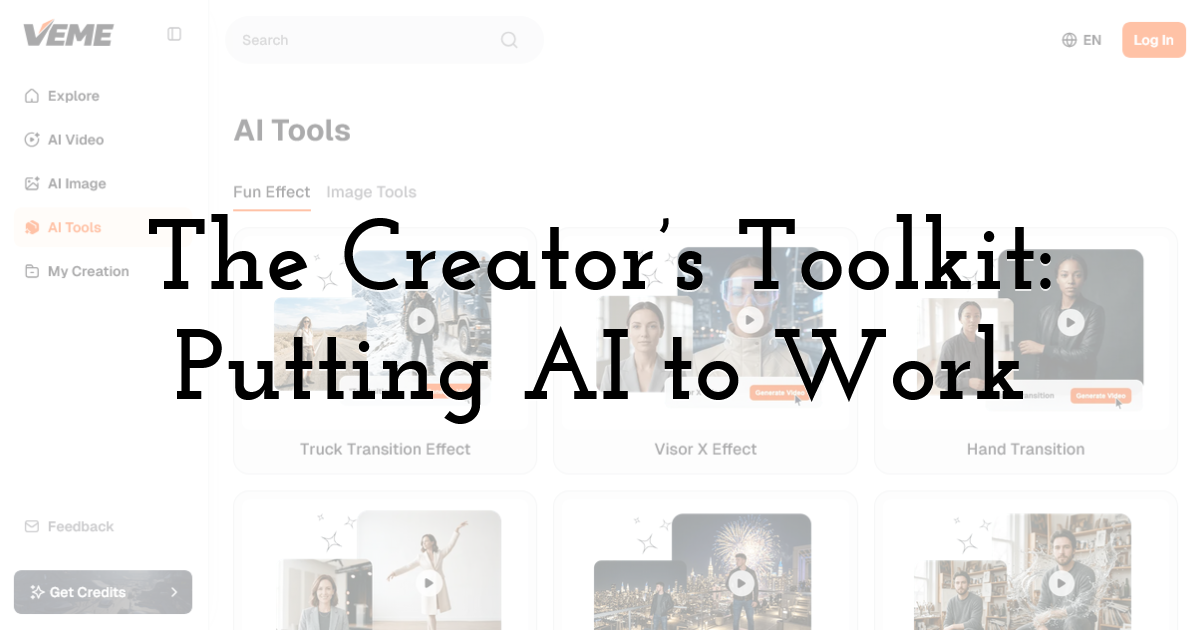
This is the main event. Turning a text prompt or a long-form podcast into a viral short used to take a human editor hours. Now, an AI Video Generator does the heavy lifting. For instance, when creators and marketers need to turn raw concepts or existing footage into polished, algorithm-friendly clips quickly, platforms like VEME step in to streamline the workflow. By utilizing intelligent video processing, it helps users scale their visual output—often allowing creators to double their weekly content cadence without sacrificing visual quality or losing their weekends to editing software.
Other tools like Runway Gen-2 are pushing the boundaries of text-to-video, allowing filmmakers to generate B-roll footage purely from text prompts, saving thousands of dollars in stock footage licensing.
Playing It Smart: Guardrails for AI Creators
If you are ready to jump into the AI content game, you need a strategy. Blindly generating and posting content is a one-way ticket to algorithmic jail. Here are a few critical things to keep in mind:
- • You Are the Pilot, AI is the Co-Pilot: Never publish raw AI output without human review. The smartest creators use AI for the "heavy lifting" (cutting out silences, adding captions, generating background assets) but rely on their own intuition for the final creative polish
- • Fact-Check Everything: AI models "hallucinate." If you are using AI to generate educational content or news summaries, verify the data. Trust takes years to build with an audience and seconds to lose.
- • Inject Your Personality: Algorithms might prioritize retention rates, but humans connect with humans. Use AI to optimize the pacing, but make sure your unique tone of voice, humor, or aesthetic shines through the data-driven perfection.
Peering into the Crystal Ball: What’s Next?

If today’s AI feels like magic, tomorrow’s will feel like telepathy. The future of AI video generation is hurtling toward hyper-personalization.
Gartner predicts that by 2025, 30% of outbound marketing messages will be synthetically generated. But for video, it goes deeper. We are moving toward an era where short videos might be generated on the fly for the individual viewer. Imagine scrolling through your feed and seeing a video ad where the AI has dynamically adjusted the background music, the narrator’s accent, and the color grading based on your personal behavioral data to maximize your engagement.
Furthermore, Multimodal AI will become the standard. Instead of using separate tools for text, audio, and video, next-generation models will allow you to input a rough sketch, a hummed melody, and a text prompt, outputting a fully mastered music video in minutes.
Final Thoughts:
We are standing at the precipice of the biggest shift in media production since the invention of the smartphone camera. Smart data has given AI the map, and video generation tools are driving the car.
Yes, there are challenges regarding authenticity and copyright. Yes, the internet is about to get a lot more crowded. But for the creators, marketers, and businesses willing to adapt, the opportunity is unprecedented. AI video generation isn't here to replace the storyteller; it is here to remove the friction between your imagination and the screen. Embrace the data, master the tools, and start building. The feed is waiting.
Until next time, Be creative! - Pix'sTory
Recommended posts
-

Why Simple Video Edits Can Make Your Marketing More Effective
Read More › -
Why AI Voices and Avatars Are Reshaping Video Content Creation
Read More › -
What Is the Fastest AI Video Generation Model?
Read More › -

Presence Effect: Using Interactive Content and Video in Jewelry Advertisi...
Read More › -
A Video Transcript Generator Fixes the One Problem Video Can't Solve on I...
Read More › -

Best AI Tools to Fix Blurry Images
Read More ›