5 Best Cloud Construction ERP Systems for Smarter Project Planning and Control
Construction ERP software helps contractors connect project planning, accounting, procurement, field work, and reporting in one place.
For many construction teams, that means fewer disconnected spreadsheets, clearer job-cost visibility, and better control over schedules and budgets.
The right platform depends on the type of work a company manages, from general contracting and land development to public infrastructure, heavy civil work, and commercial service operations.
This list reviews five cloud construction ERP systems and explains where each one fits best.
1. Premier Construction Software
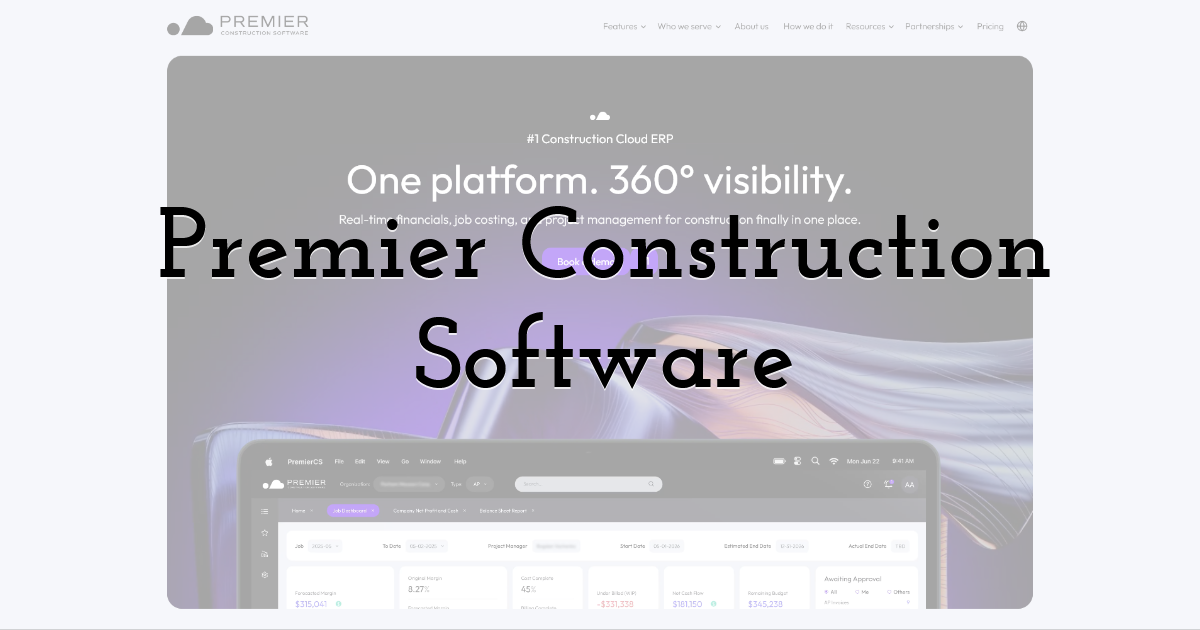
Premier Construction Software is a cloud-based construction ERP platform for contractors that need accounting, job costing, project management, field management, drawings, and document control in one connected system.
Its official site describes it as an all-in-one construction management system, and review platforms note strong feedback for customer support, billing, invoicing, multi-project management, and planning tools.
Key Features
The platform supports construction accounting, job costing, WIP reporting, project forecasting, RFIs, change orders, drawings, and document control.
Real-time project data helps teams connect commitments, actuals, estimates, and change orders with project budgets and schedules.
It is also built to reduce duplicate entries between financial and project workflows. For growing contractors, this can make it easier to track costs, review margins, manage approvals, and keep field and office teams working from the same information.
Best For
This construction ERP system fits general contractors, developers, and construction firms that need stronger financial visibility across multiple projects or entities.
It is especially useful for teams moving away from disconnected accounting, project management, and field tools.
Pros
- • Automated connection between project management and accounting
- • Strong job costing and cost tracking
- • Mobile field access
- • Centralized document management
- • Useful reporting for project and financial teams
2. Aurigo Software
Aurigo Masterworks is built for public agencies and capital infrastructure programs rather than traditional commercial contracting.
The platform supports planning, funding, construction management, and operations for public infrastructure projects. Aurigo says it is used by more than 300 customers, and FedRAMP lists Masterworks Cloud as a capital planning and construction management solution for public agencies.
Key Features
Aurigo Masterworks includes tools for capital planning, construction tracking, cost management, funding, compliance, and asset operations. Its product suite is structured around planning, building, and operating capital programs.
The platform also supports government compliance needs. Software Advice lists Aurigo Masterworks Cloud as FedRAMP and StateRAMP compliant and SSAE-18 Type II certified.
Best For
Aurigo is best for public agencies, municipalities, transportation departments, and facility owners managing large capital programs. It is a strong fit where funding control, audit trails, compliance, and long-term infrastructure planning matter.
Pros
- • Built for public sector capital programs
- • Supports planning through operations
- • Strong compliance credentials
- • Useful for large infrastructure portfolios
- • Reduces manual data entry across workflows
3. Bentley Systems
Bentley Systems focuses on infrastructure engineering, design, construction, and asset operations. Its tools are widely used by teams working on roads, bridges, utilities, plants, rail, and other infrastructure assets.
Key Features
Bentley’s SYNCHRO suite supports 4D construction planning, cost control, field progress tracking, daily reporting, and construction model coordination.
Its broader software ecosystem includes MicroStation, ProjectWise, iTwin, OpenRoads, OpenRail, and OpenBridge for design, collaboration, digital twins, and asset lifecycle management.
Best For
Bentley is best for engineering firms, infrastructure owners, and contractors managing complex assets from design through construction and operations.
Pros
- • Strong infrastructure lifecycle coverage
- • 4D and 5D construction planning
- • Digital twin capabilities
- • Office-to-field collaboration
- • Designed for large infrastructure datasets
4. B2W Software
B2W Software, now part of Trimble, is built for heavy civil and highway contractors. It focuses on estimating, field tracking, equipment maintenance, and scheduling for work such as earthwork, paving, utilities, and transportation projects.
Key Features
B2W Estimate helps teams manage labor, materials, equipment, crews, pay items, and bid structures. B2W Track captures daily field logs, actual costs, quantities, equipment use, and labor details.
B2W Schedule supports centralized resource scheduling, while B2W Maintain handles work orders, preventive maintenance, telematics data, and equipment workflows.
The platform connects estimating with field execution so contractors can compare planned costs with actual results.
Best For
B2W is best for heavy civil contractors, highway firms, paving companies, and earthwork contractors that need detailed estimating and field-cost tracking.
Pros
- • Strong estimating and field tracking
- • Built for pay-item and WBS-heavy projects
- • Useful equipment maintenance workflows
- • Offline mobile access for field teams
- • Good fit for DOT-style project requirements
5. BuildOps
BuildOps is designed for commercial contractors that manage both service and project work.
Its platform supports HVAC, plumbing, electrical, fire protection, refrigeration, and other specialty trade contractors.
Key Features
BuildOps brings service management, project management, financial workflows, CRM, dispatch, field communication, and mobile tools into one platform.
Its official site describes the product as one place for commercial contractors to run services and projects, with AI built into the platform.
The system helps connect field crews, dispatchers, finance teams, and sales teams. That makes it useful for contractors that need to manage service calls, project work, invoicing, time tracking, and customer communication without switching between separate systems.
Best For
BuildOps is best for commercial subcontractors and specialty trade contractors that handle both recurring service work and larger construction projects.
Pros
- • Built for commercial service and project work
- • AI features integrated into core workflows
- • Useful mobile tools for field crews
- • Connects dispatch, finance, sales, and operations
- • Good fit for multi-trade contractors
Final Thoughts:
The best cloud construction ERP system depends on the work your company performs and the controls you need most. General contractors may prioritize job costing, WIP reporting, and financial visibility.
Public agencies need compliance, capital planning, and infrastructure program oversight. Heavy civil contractors often need stronger estimating, field tracking, and equipment workflows, while specialty contractors may need service and project management in one platform.
Before choosing software, review your current gaps, map the workflows that create the most delays, and select a system that connects field activity, project data, and financial reporting practically.
Until next time, Be creative! - Pix'sTory
Recommended posts
-
How Upgrading Your Software Improves Your Business
Read More › -

7 Best Photo Recovery Software to get Back Your Images
Read More › -
How Better Time Visibility Can Improve Operational Efficiency
Read More › -

Custom Software on High Alert: An Active Logic Review for 2026
Read More › -
Top 7 Remote Team Monitoring Software Compared in 2026
Read More › -

The Best SEO Software for Agencies in 2026, Judged by the Jobs It Has to...
Read More ›