Best AI Detector for Teachers and Universities in 2026: 6 Tools Ranked by False Positive Risk
Every teacher who has run a suspicious essay through an AI checker knows the feeling that follows, whichever of the AI detection tools they used: a number appears on the screen, and nothing about it tells you what to do next.
A 92% AI score on a student's history paper is not evidence. It is a probability estimate from an AI detection model, produced by a company that would very much like you to trust it. And the same AI score can mean very different things depending on which of the AI tools produced it.
That is the central problem with choosing the best AI detector for a school. The AI detection tools that market hardest are not always the tools that treat human written content fairly, and the cost of getting it wrong falls on students, not on the vendor. Vanderbilt University switched off Turnitin's AI detection in August 2023 after calculating that even the vendor's advertised 1% false positive rate would mean roughly 750 wrongly flagged papers a year.
This guide ranks six AI detectors for classrooms, departments, and integrity offices. It is written for people who will act on an AI score from one of these tools, which means it weighs false positives, sentence-level detail, and evidence of the writing process above headline accuracy claims.
Several well-known tools, including ZeroGPT and Originality.ai, are discussed but not ranked, because they are built for other users. Prices are current at the time of publication and may change; check each vendor's site before you buy.
The best AI detector for educators in 2026 is one that highlights flagged sentences, explains its false positive rate, and pairs an AI score with writing process evidence. Eliten's AI Content Detector leads for quick, private checks with a plain-language verdict; Pangram, GPTZero, Turnitin, Copyleaks, and Winston AI cover institutional scale, LMS integration, and plagiarism checking.
How we ranked the best AI checkers for classrooms
An AI detector that is right 95% of the time on raw AI content can still be the wrong choice for a school if it flags one in ten human written essays as AI. False positives, not false negatives, are the cost that matters.
So the ranking below weighs five things.
Transparency about false positives. Does the vendor publish a false positive rate, describe the training data behind its AI detection model, and explain what kinds of human written text trip it? Vague claims of 99% accuracy without a methodology count against an AI detector tool, not for it.
Sentence highlights, not a single number. A document-level AI detection score tells you almost nothing. Sentence-level or paragraph-level highlighting lets you see whether the flagged AI content is the thesis statement or a bibliography entry.
Evidence of the writing process. The strongest defense against a false accusation is a record of how the essay was written: drafts, version history, and typing patterns in Google Docs. Tools that capture this let a student prove authorship and reduce the weight you have to put on the AI score.
Fit with how schools already work. Chrome extension, Google Docs integration, LMS plugins for Canvas or Moodle, other features such as plagiarism checking, and a privacy policy a records officer would accept. Tools that live where the essays are written win here.
Cost per seat. Some AI tools are priced for a single teacher; others only make sense for a district or a university with a procurement office.
Run three tests before you trust any AI checker
Before adopting one AI detector across a department, run three tests on it yourself. Each takes ten minutes, and the test results tell you more than any marketing page.
Test 1: raw AI output. Ask ChatGPT or Gemini for a 500-word essay on a syllabus topic. Paste text straight in. A competent AI detector should detect AI content in most of it. If the tool catches nothing here, it is not worth further time.
Test 2: human written text from a non-native writer. Take human written text from a student whose first language is not English, ideally a strong, formal piece. This is where most detection tools fall down, and where false positives on human written content are most likely.
A Stanford study led by Weixin Liang, published in Patterns in 2023, ran essays written by non-native speakers for the TOEFL exam through seven detectors and found they flagged an average of 61% of them as AI generated writing. Native-speaker essays were almost never flagged. The same AI tools produced completely different test results on the two sets of human written text, proof that human written content is not one category to an AI detector.
Test 3: mixed and edited text. Take a human written draft, ask an AI to improve two paragraphs, then paste the whole thing.
Most detection tools struggle with heavily edited or mixed text, and the AI score often lands in a vague middle range. What matters here is whether the highlighted sentences are the right paragraphs, and whether the tool works the same way on a second, similar sample.
Compare the test results across two or three tools.
If multiple tools disagree wildly on the same human written essay, the AI score alone cannot carry an accusation.
Comparison: AI detection tools for education at a glance
| Tool | Best for | Sentence highlights | Writing process evidence | Entry pricing |
|---|---|---|---|---|
| Eliten AI Content Detector | Quick, private checks with a clear verdict | Yes | No | Sign up with starter tokens; paid plans on the site |
| Pangram | Low false positive rate, segment-level detail | Yes | No | Individual plan around $20/month; institutional plans |
| GPTZero | Google Docs writing replay and classroom scale | Yes | Yes | Free tier; paid from about $8.33/month annual |
| Turnitin | Institution-wide integrity, LMS-native | Yes | Yes (Turnitin Clarity) | Institutional licence only |
| Copyleaks | AI plus plagiarism checker across languages | Yes | No | Personal plans in the mid-teens per month annual |
| Winston AI | OCR for handwritten and scanned work | Yes | No | Essential around $10/month annual |
1. Eliten AI Content Detector
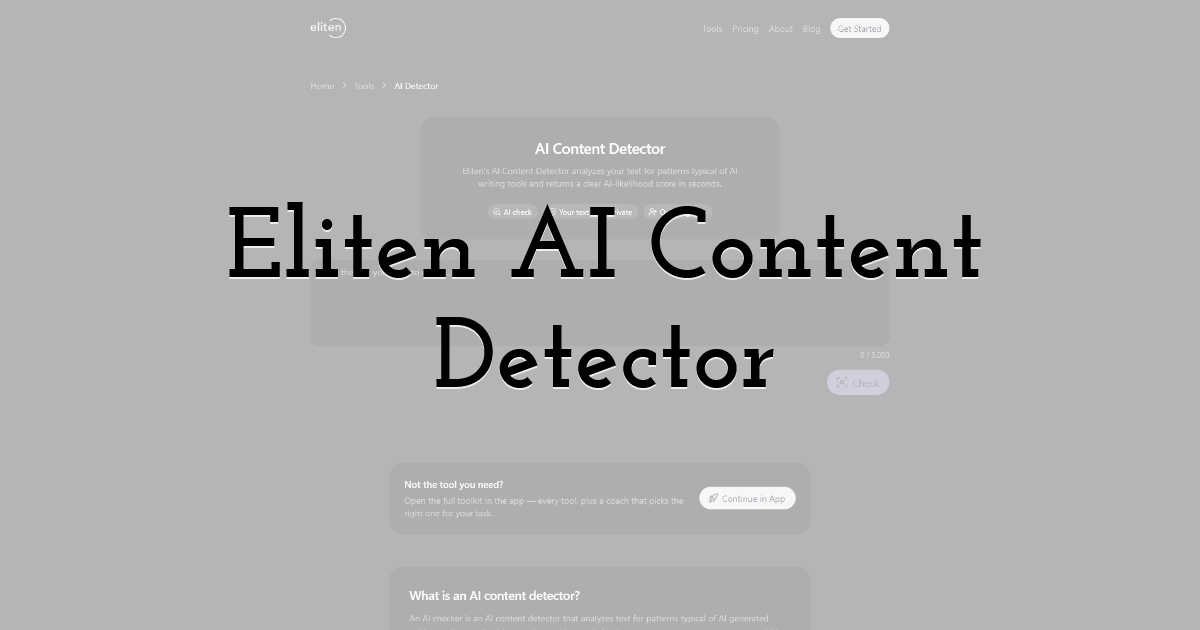
Eliten's AI Content Detector takes the top spot for the situation most teachers are actually in: one essay, one question, five minutes before the next class.
You paste text or upload a file, click "Check for AI", and get an AI-likelihood score with a plain-language verdict: human written, mixed, or likely AI. The report highlights the sentences that look machine-generated, so you can detect AI passages inside otherwise human written content instead of staring at a bare percentage.
Best for: Teachers and teaching assistants who need a fast first read on a submission, explained in words rather than a number. It is also a sensible AI checker to recommend to students who want to self-check a draft before submitting.
What it does well:
The verdict is designed for decisions. Instead of "73%", you get context on the AI content: whether the text reads as human written text, whether it is mixed, and which sentences carried signs of AI writing.
The text paste box accepts an essay, an article, or a research paper section. The detector looks for the shared writing patterns of current AI models, including ChatGPT, Gemini, and Claude, and is explicit that newer models are covered by pattern rather than by name.
Privacy is handled the way a school would want: pasted text is not permanently stored or used to train AI models, which matters when the text is a minor's coursework. Each AI check handles up to 5,000 characters, roughly 800 words, so a long essay is checked in two or three passes.
Eliten's own page states that no AI detector is 100% accurate, explains why structured academic writing triggers false positives, and tells educators to treat the score as one signal. That is exactly what a school policy should say about AI tools.
Pricing: Sign up takes a minute and comes with starter tokens, so you can run several checks before deciding anything. Paid plans start from the tiers listed on Eliten's pricing page; check the site for current figures.
Watch for: There is no LMS plugin and no writing replay, so for a formal misconduct process pair it with Google Docs version history or other tools from this list. The 5,000-character limit means a 3,000-word dissertation chapter takes multiple passes.
2. Pro AI Checker
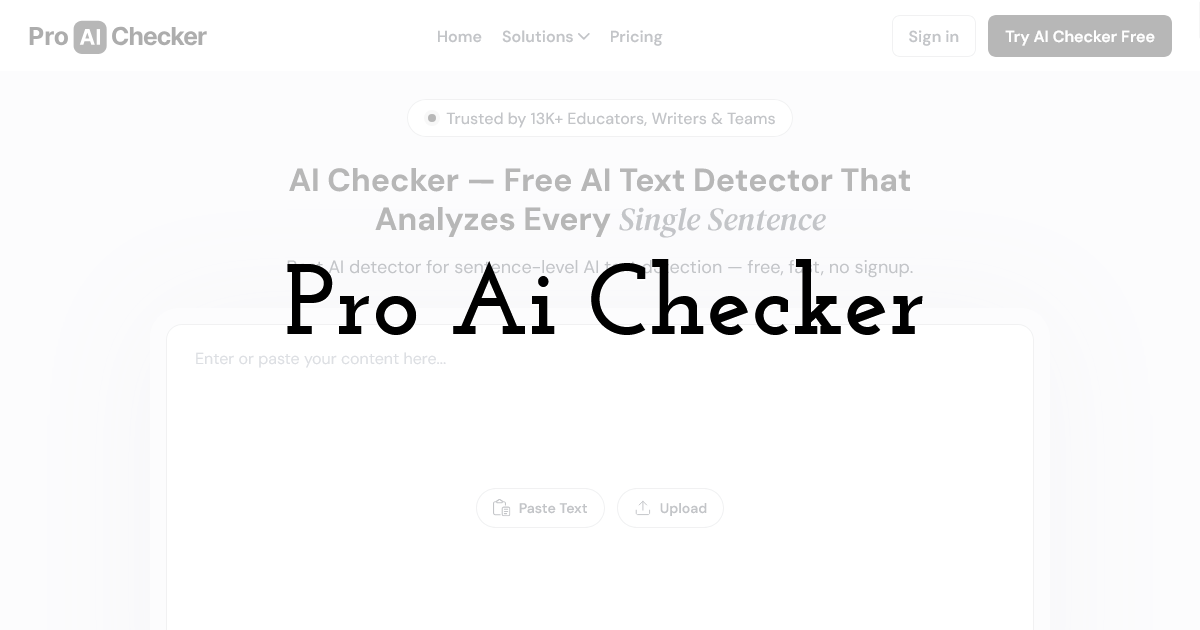
Pro Ai Checker is a practical option for teachers who want a quick way to review student submissions for signs of AI-generated writing. It provides an AI likelihood assessment that can help educators identify content that may deserve a closer look before starting a conversation with a student.
Best for: Teachers who need a straightforward AI checker for reviewing essays, assignments, and other student writing without adding a complicated detection workflow.
What it does well:
Pro Ai Checker gives teachers a quick way to analyze written content and identify patterns commonly associated with AI-generated text. Instead of relying on the result as proof of misconduct, educators can use the assessment as one signal alongside drafts, writing history, classroom performance, and other evidence.
The tool is also useful when teachers want students to review their own work before submission. Students can check a draft, identify sections that may appear AI-generated, and make appropriate revisions while maintaining their own writing style.
For educators handling multiple types of assignments, the simple workflow makes Pro Ai Checker useful as an additional check alongside existing classroom tools. It can fit into a teacher's review process without requiring a full institutional AI detection platform.
Pricing: Check the Pro Ai Checker website for the latest available plans and usage limits.
Watch for: Like other AI detection tools, Pro Ai Checker should not be treated as definitive proof that a student used AI. Detection results can vary based on writing style, editing, and the type of content being analyzed. Use the result as a starting point for further review rather than as the sole basis for an academic integrity decision.
3. Pangram
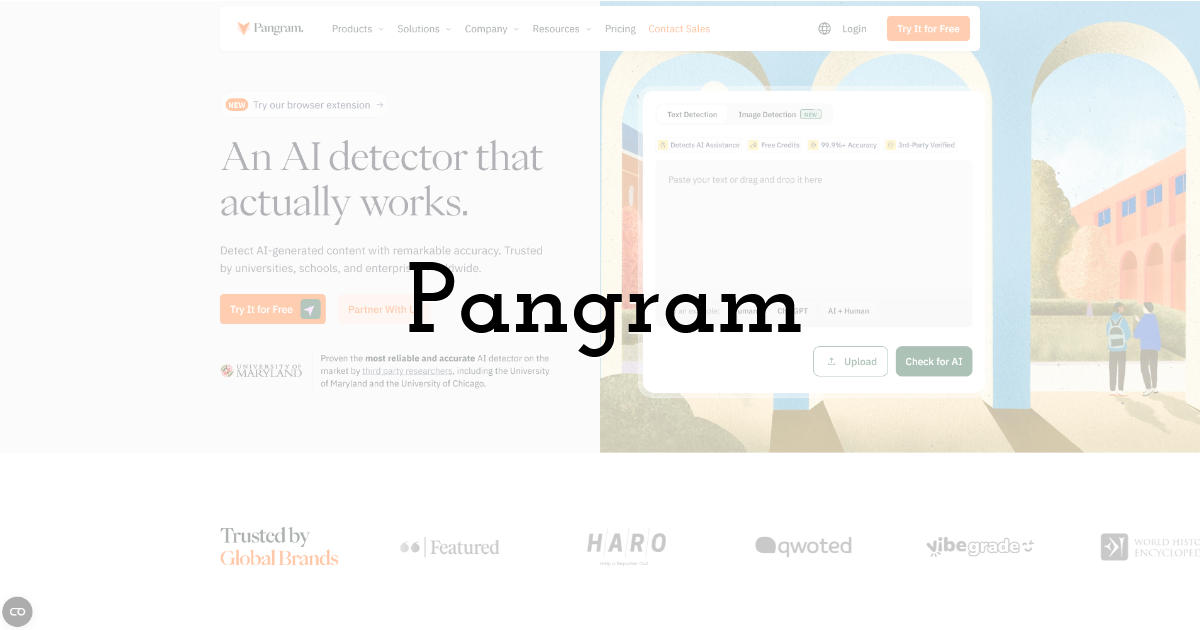
Pangram is the detector to look at if your main fear is the false accusation.
Its AI detection model produces segment-level results with a four-tier classification, so a paragraph can be labelled lightly AI-assisted rather than simply flagged. The company publishes a very low false positive rate, backs it with outside academic evaluations of its AI detection model, and publishes research on its training data and methods, which is more than most vendors offer.
Best for: Integrity offices that need results they can defend in a hearing, and schools that want automatic AI checks inside Canvas or Google Classroom.
What it does well:
The segment analysis is the strongest in this list.
Instead of one AI score, you see which sections of the document look like AI generated writing, which look edited, and which look human written, with interpretability notes on what triggered each flag. Detection covers more than 20 languages, and the Chrome extension and Google Docs integration let a teacher check inside the document.
Institutional plans add a plagiarism checker, OCR for scanned uploads, usage dashboards, and a commitment not to train on student data.
Pricing: A limited number of checks per day is available without paying. The Individual plan is around $20 per month; a Professional tier and institutional licences sit above that. Check the site for current figures.
Watch for: Pangram itself says mixed human and AI drafts are its hardest case, and independent testing agrees. The daily cap in the free version is small, so a teacher checking a full class set will need the paid version.
4. GPTZero
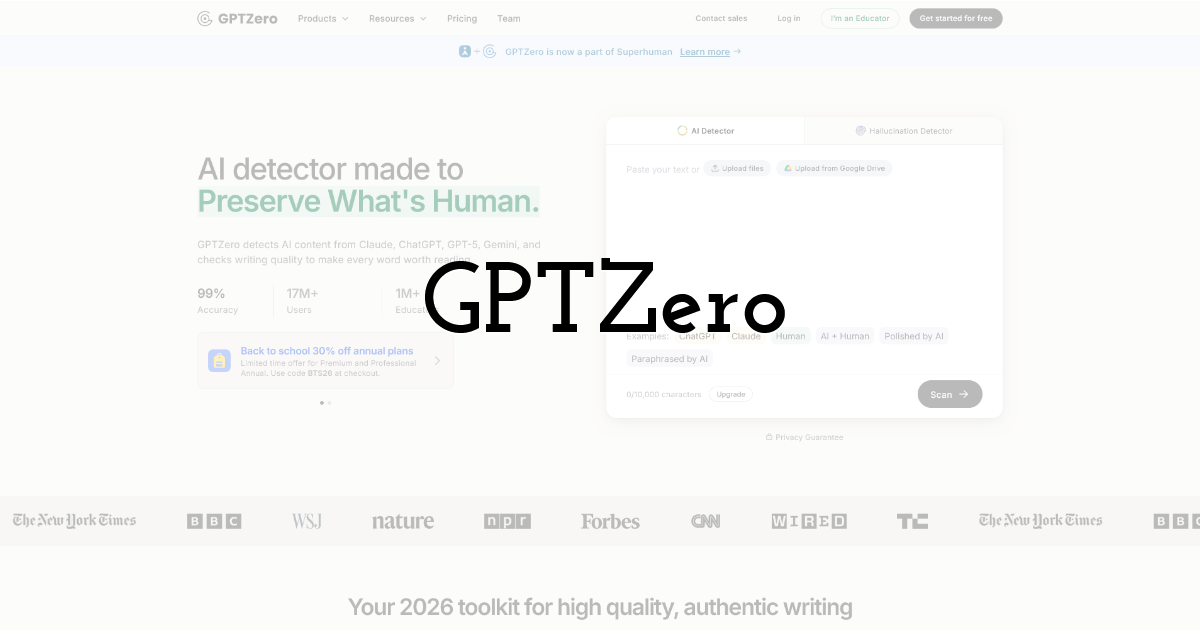
GPTZero is the most widely deployed AI checker in education.
By the company's own count it has served more than ten million users and works with thousands of institutions, and it is the official AI detection partner of the American Federation of Teachers. Its real advantage for schools is not the AI detection model but the writing report, which lets students prove authorship with their own writing history.
Best for: Schools that run on Google Docs and want to see how an essay was written, not just how it ended up.
What it does well:
The GPTZero Chrome extension adds a live AI score above the Google Docs toolbar and, more importantly, a writing replay: a video of the document from first keystroke to final edit, with typing pattern analysis that flags large pastes.
It supports multiple editors, so group work can be attributed by percentage. For a teacher, this writing history is far stronger evidence than any AI score, in either direction, and it is the one feature no other tools on this list match inside Google Docs.
GPTZero also shows sentence highlights for AI content, holds SOC 2 certification, and states FERPA compliance, which matters for a records request.
Pricing: There is a standing free version with a monthly word cap; an account is needed even for that. Essential is $14.99 per month, or about $8.33 per month on annual billing, for 150,000 words; Premium is $23.99 monthly or about $12.99 annual for 300,000 words with batch uploads and team seats.
Institutional pricing is by quote. Check the site for current figures.
Watch for: GPTZero's false positive rate on non-native and formal writing has been questioned in independent tests, and its own guidance says to look for a long-term pattern of AI use rather than a single flag.
5. Turnitin
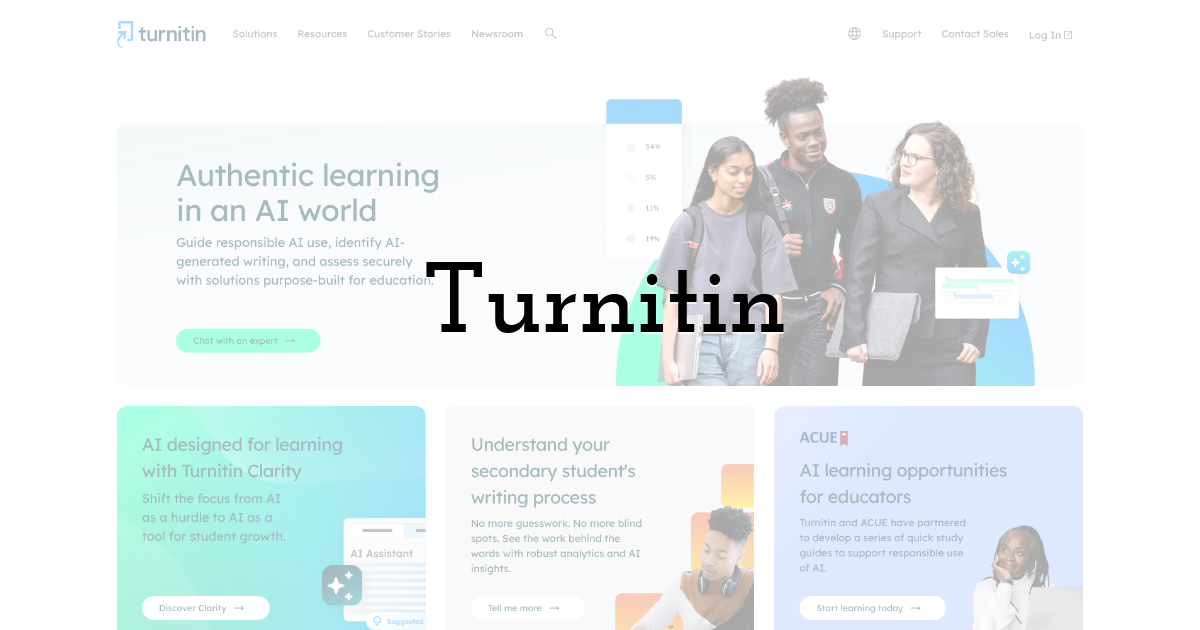
Turnitin is the incumbent among AI detection tools for universities.
If your institution licences it for plagiarism checking, AI detection is likely already in your Similarity Report, with no separate sign up. That convenience is also the risk: an AI score appears next to every submission whether or not anyone has thought about how to use it, and false positives arrive at scale.
Best for: Universities and school districts that need one integrity platform inside the LMS, with a plagiarism checker and AI detection in a single report.
What it does well:
Turnitin's own published numbers, on clean unedited text, claim a document-level false positive rate under 1% for documents with at least 20% AI writing, and around 4% at the sentence level.
The AI indicator does not surface at all below a minimum word count, which is sensible. Turnitin has also added a writing environment, Turnitin Clarity, that records the drafting process so an instructor can see how the work developed.
Pricing: Turnitin is sold to institutions only. There is no individual plan and no public price list; contact your integrity office or Turnitin's sales team.
Watch for: Those false positive figures are the vendor's own, and Vanderbilt's decision came from doing the maths on what 1% means across tens of thousands of papers. Turnitin itself tells instructors that the AI score should not be the sole basis for a misconduct finding.
6. Copyleaks
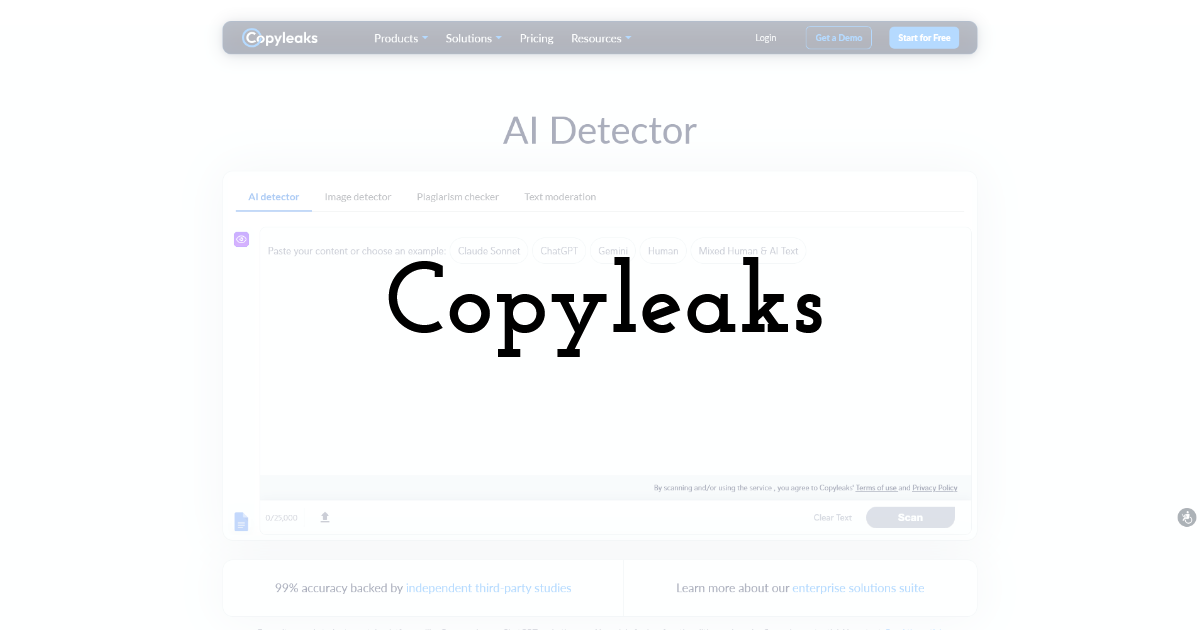
Copyleaks started as a plagiarism checker and added AI content detection later, which makes it a natural fit for schools whose integrity workflow is already built around similarity reports. It is one of the few tools that handles AI writing, plagiarism, and source code in one scan.
Best for: Departments that need multilingual detection and want AI detection and plagiarism checking from one vendor without an institution-wide Turnitin contract.
What it does well:
Copyleaks can detect AI content in multiple languages, highlights flagged sentences, offers LMS integrations for institutional customers, and includes API access on paid tiers, so a university can build detection into its own submission system.
Pricing: Copyleaks uses credits. Personal plans start in the mid-teens per month on annual billing, with credits that reset monthly; education plans are quoted per seat. Check the site for current figures.
Watch for: Detection of paraphrased AI text, or text run through AI humanizing tools such as Undetectable AI, drops sharply in third-party tests, as it does for every AI detector tool. Unused credits do not roll over.
7. Winston AI
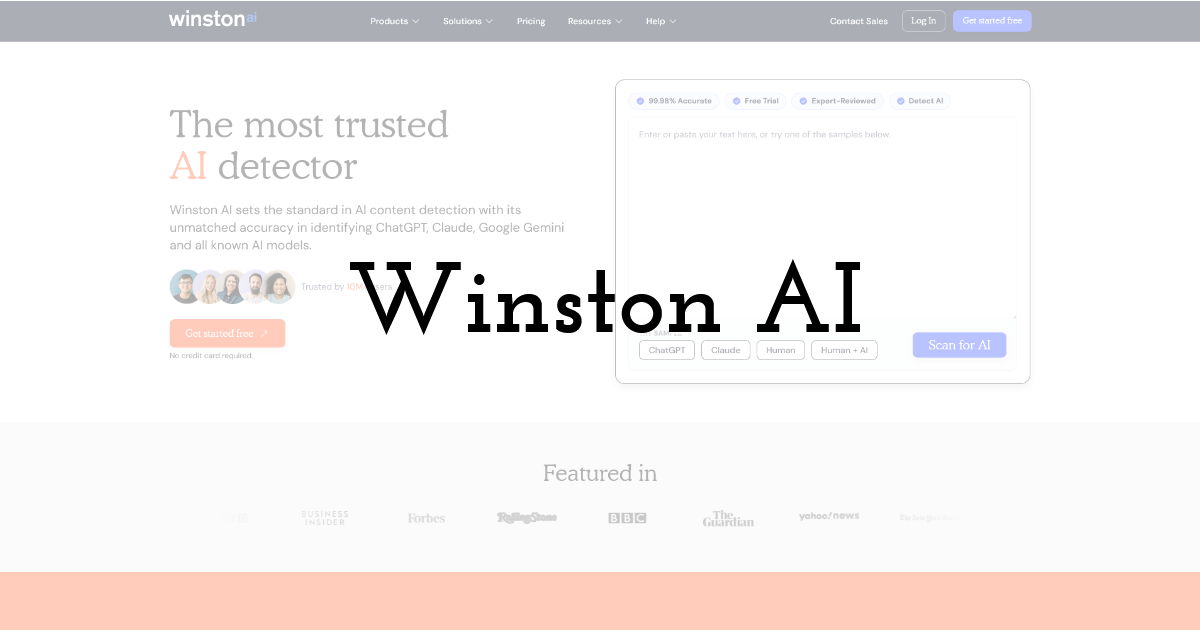
Winston AI earns its place for one feature no other detection tool here matches: OCR.
It reads handwritten notes, scanned worksheets, and photographed exam booklets, then runs AI detection and a plagiarism check on the extracted text. For schools that still collect paper, that is the whole reason to use it.
Best for: Teachers grading scanned or handwritten submissions, and departments that want a PDF report for the file.
What it does well:
Winston AI gives a sentence-level map of what it thinks is AI writing, generates shareable PDF reports, and includes AI image detection for coursework with generated illustrations at no extra cost on paid tiers. Its Advanced tier adds team seats.
Pricing: A 14-day trial includes 2,000 credits, about one essay. Essential is around $10 per month on annual billing for 80,000 credits (one credit per word for AI detection, two per word for plagiarism), Advanced around $16, and Elite around $26. Monthly billing is higher. Check the site for current figures.
Watch for: Winston AI advertises 99.98% accuracy. Treat that as marketing: it is self-reported and no independent benchmark has reproduced it. Credits run out faster than you expect if you turn on the plagiarism checker for every scan.
How do AI detectors work, and why do they misfire on student writing?
Most AI detectors work by measuring how predictable a text is, which is also how the tools mentioned above differ from a plagiarism checker: they look for patterns, not copied sources.
Language models write the statistically likely next word, so raw AI text has low "perplexity" (few surprises) and low "burstiness" (little variation in sentence length and rhythm). An AI detection model trained on large amounts of human written text and machine text learns those patterns from its training data and returns a probability.
That method has a built-in flaw for schools. Good academic writing, the kind of human written content teachers reward, is also predictable.
A student who has been taught to write clear topic sentences, keep a consistent register, and avoid slang produces text that looks, statistically, like a model's output. Non-native writers, who often use a narrower vocabulary and more regular sentence length, look even more "AI-like" to the model. This is not a bug in one product; it is a property of how AI detectors work, and it produces false positives on exactly the students least able to contest them.
The same method fails in the other direction. When AI generated writing is lightly edited, paraphrased, or blended with human written sentences, the statistical signal weakens, detection rates drop, and false negatives rise.
Why false positives cost more than false negatives in education
A false negative means AI generated writing gets through as human written work. That is a missed teaching moment. False positives mean a student who did the work is accused of cheating, and in most institutions that accusation is very hard to undo.
Independent research has been consistent on this. Beyond the Stanford study, a 2023 study led by Debora Weber-Wulff in the International Journal for Educational Integrity tested 14 detection tools and found none reached 80% accuracy, with machine-paraphrased text especially hard to catch.
The RAID benchmark presented at ACL 2024 found that simple adversarial edits fooled most AI detectors.
OpenAI withdrew its own text classifier in July 2023, citing low accuracy.
None of this means these AI tools are useless. It means their output is a signal with a known rate of false positives and false negatives, and a school policy has to be built around that error rate rather than around the vendor's accuracy claim.
What should a school's AI detection policy actually say?
A workable policy has four parts, and the AI tools you choose should support each of them.
The score is one signal. No misconduct finding rests on an AI score alone, from one tool or from multiple tools. The policy should say this in writing, and list what other evidence counts: drafts, version history, a writing replay, a conversation about the essay.
Thresholds are set locally. Decide what AI score from which AI checker triggers a conversation (not an accusation) and write it down.
Students can show their work. Students should know in advance that writing history in Google Docs is their protection, and that they can be asked to walk through their writing process. This turns a Chrome extension from surveillance into a safeguard.
Use more than one tool for serious cases. Where a case is heading toward a formal finding, run the text through at least one other tool. If different AI detection tools disagree on the same human written passage, the disagreement should be recorded, and only one tool should never be enough.
Is a 40% AI score bad?
Not on its own.
A 40% AI score means the AI checker estimates that roughly two fifths of the text matches AI patterns. Most tools would label that "mixed", and mixed is where edited human written text, heavily revised AI drafts, and formal academic writing by non-native speakers all tend to land.
Look past the number at the highlighted sentences. If the flagged 40% is a block of generic transition sentences, the writer may have leaned on AI tools for polish.
If it is scattered across topic sentences and citations, you are probably looking at false positives on structured human written text. Either way, a 40% AI score is a reason to ask questions, not to act.
Is ZeroGPT better than Turnitin?
They are different kinds of AI detection product, and the comparison only makes sense in one direction. Turnitin is an institution-only platform integrated into the LMS, with vendor-published false positive figures and a policy framework around them.
ZeroGPT is a consumer-facing AI checker that anyone can use with no sign up required and a large text paste limit, with a paid version for higher limits. In independent tests, ZeroGPT has shown noticeably more false positives on human written text than the institutional tools, and third-party accuracy estimates vary widely by text type.
For a school, free tools like ZeroGPT do not replace Turnitin. For a student, the useful point is that a ZeroGPT result does not predict a Turnitin result: the two use different AI models and thresholds, and a draft that passes one can fail the other.
Frequently asked questions
Which AI detector is the most trusted by universities?
By deployment, Turnitin and GPTZero are the most widely used in higher education, with Copyleaks and Pangram growing.
"Most trusted" and "most accurate" are not the same thing, though. Trust in a school setting comes from published false positive data, sentence-level detail, writing process evidence, and student data protection, which is why this guide ranks the best AI detectors on those criteria rather than market share.
What is actually the most accurate AI detector?
No single answer survives independent testing. Vendors publish figures from 98% to 99.98%; peer-reviewed and third-party benchmarks report lower and far more variable results, especially on edited and non-native text.
Pangram and Originality.ai have led several recent third-party tests on raw AI output, while tools with the fewest false positives on human content tend to be the ones that surface segment-level detail. The best AI detector for a school is the one whose errors you understand. The honest ranking is: accurate enough to start a conversation, not accurate enough to end one.
Can AI detectors detect text from GPT-5, Gemini, and Claude?
Most current tools detect AI output from the latest models most of the time when it is unedited, because the statistical patterns are shared across model families. Accuracy is lower on newer AI models and lower still once the text is edited, so a vendor that names specific models on its homepage is promising nothing about the next release.
Do AI detectors work for non-English essays?
Some do, with caveats. Pangram, Copyleaks, and Eliten can detect AI text in several languages, and GPTZero covers a number too.
None of the tools mentioned here is completely free of language bias. Accuracy outside English is lower and less tested, and the non-native bias documented in English almost certainly has equivalents elsewhere. Treat a non-English AI score as weaker evidence.
Should students check their own drafts before submitting?
It is reasonable, and many already do with a free check on free tools such as ZeroGPT, Scribbr, or QuillBot, which need no account, or on the free version of a paid AI checker. The caveat teachers should share is that a pass on one tool does not guarantee a pass on the school's tools, and that a student's best protection is a clear writing history, not a clean AI score.
Final Thoughts:
For most teachers, the practical setup is two tools, not six, and certainly not more tools than that.
Eliten's AI Content Detector is the best AI detector for the quick, private check, with a plain-language verdict and sentence highlights that show where the concern is. GPTZero's Google Docs writing replay, or Turnitin Clarity if your institution has it, supplies the writing process evidence that turns an AI score into something you can act on fairly.
Pangram is the pick when the stakes of false positives are highest and you want segment-level detail on AI content. Copyleaks fits schools that want a plagiarism checker and multilingual AI content detection from one vendor's tools, and Winston AI is the only tool here that will read a scanned exam booklet. Whichever tools you choose, run the three tests first, write the policy before the first flag, and never let a number decide for you.
Until next time, Be creative! - Pix'sTory
Recommended posts
-
From Research to Ready-to-Present: How HIX AI Slides Simplify Presentatio...
Read More › -
Stop Searching for Stock Images and Start Creating Your Own With AI
Read More › -
How Game AI Design Influences User Retention: Lessons from Rust
Read More › -
What Is the Fastest AI Video Generation Model?
Read More › -

The Hidden Gem for Marketers: Personalized Video at Scale
Read More › -
How to Fix Personal Emails Going to Spam from a Custom Domain?
Read More ›