How UGC Creators Are Using AI to Land Higher-Paid Brand Deals in 2026

Okay so we need to talk about the UGC creators making bank right now, because the gap between the ones eating and the ones still grinding for $50 videos is genuinely insane.
I've been watching this space for like eighteen months and the split is wild. Some creators went from $400 a month to $4K a month between March 2025 and now. Same niche. Same camera. Same face on screen. The only thing that changed? They figured out the AI thing while everyone else was still posting "AI is killing creators" rants on Threads.
Spoiler: it's not. The brands paying premium rates still want a real person filming in a real kitchen with a real iPhone. That part hasn't moved an inch. What AI actually did was nuke all the boring parts around the shoot — the scripting, the editing, the variants — so one creator can now output what used to take three. If you're not using these tools yet, you're basically choosing to work three times harder for the same money. Which… why?
What the new workflow actually looks like
So my friend J (not her real name, she'd be unhinged if I doxxed her) was doing skincare UGC last year and capped out at two videos a week. Three hours per video. $250 a pop. Math: about $2K a month, working real hours.
She rebuilt the whole thing in February. ChatGPT for hook ideas. A CapCut template library she made once and just reuses. Auto-captions. AI b-roll for product close-ups when she didn't feel like reshooting.
Production time now: 45 minutes a video. Output: nine a week. Same rate. Same niche. Same her.
I'll let you do that math but it's giving "quit your day job" energy.
This isn't unusual — it's just what the organized creators are doing. The work on camera didn't change. The work around the camera got demolished.
The four AI categories you actually need (and the ones you can skip)

Most "AI for creators" content online is honestly useless. Vague tool lists, no actual workflow, written by people who've never produced a UGC video. So here's what actually matters in practice:
Hooks and scripts. Do NOT have AI write your whole script. The output is detectable in three seconds and brands clock it instantly. Use it for hook variations only. Ask Claude (better than ChatGPT for this, fight me) for ten openings. You'll throw out eight. The other two will absolutely cook and you'll wonder why you didn't think of them yourself.
Templates and design. The unsexy one nobody talks about. The biggest time-suck in UGC is NOT filming, it's the on-screen text, callouts, captions, lower thirds. Build a template library once. Reuse forever. Every UGC creator I know who actually makes good money has a personal template stash they guard like it's a Birkin.
Editing. CapCut. Just CapCut. The interface is fine but the AI features inside are what's actually changing the game. Auto-captions that are accurate enough to ship without checking. Auto-cut on silence. Background removal. None of this existed two years ago and now it's free. Creators still manually editing in Premiere are losing for literally no reason.
Voiceover. Selective use only. Brands want your real voice on camera. But for b-roll, walkthroughs, or translating one shoot into three languages — ElevenLabs is doing real work. Don't lean on it for anything where your face is on screen.
Why tech brands are paying so much more (and why you should care)
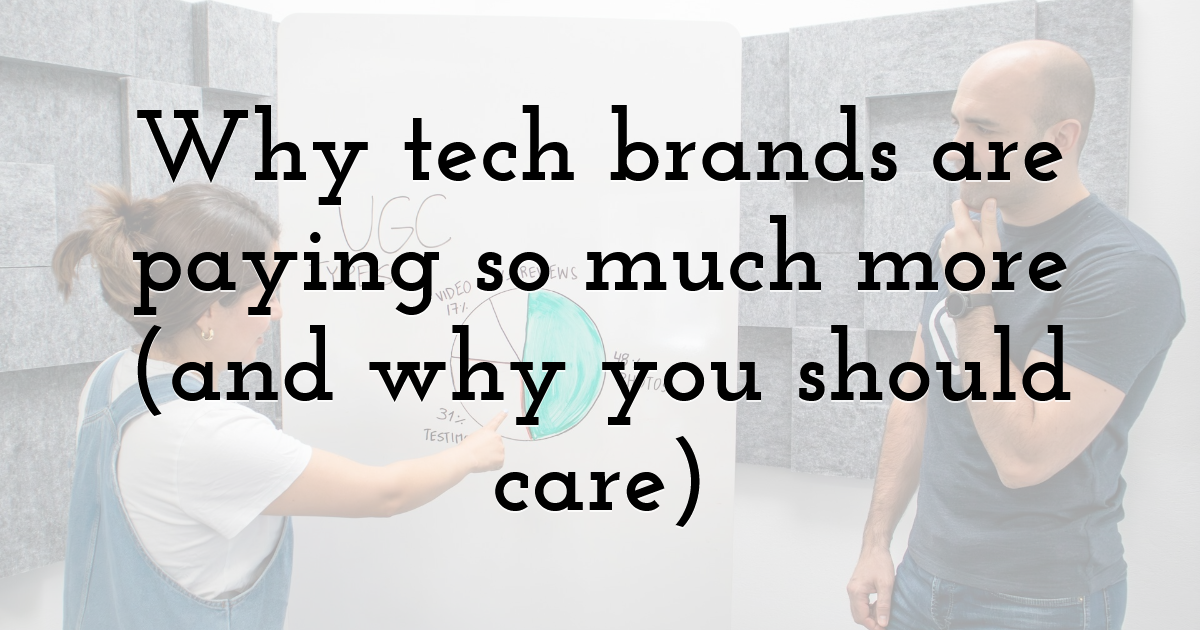
Tech UGC pays different. Like, embarrassingly different.
The reason is boring but important: tech brands (SaaS, apps, B2B software) have higher customer lifetime values. A SaaS company landing a $99/month subscriber from a paid ad genuinely does not care if the creative cost them $300 or $700. They care if it converts. So they pay for quality and they pay for volume.
Going rate I'm seeing right now: $250-$800 per video for solo creators, with the experienced ones absolutely commanding the top end. Add usage rights and a 12-month exclusive can double the base rate easily.
Tech brands also want variants. Lots of them. Ten openings, four CTAs, three different framings — all from one shoot. This is precisely the work AI-augmented creators eat for breakfast and manual creators choke on. If you can deliver ten clean variants from a single shoot, you're exactly who tech brands are throwing money at right now.
And here's the part most people miss: the supply gap in tech UGC is huge. Most lifestyle creators tap out of tech because they think they need to be "techy." They don't. The brands hiring don't want polished tech reviewers — they want lifestyle creators who can authentically use a product. A busy parent demoing a meal-planning app crushes a polished tech YouTuber doing the same demo. Every. Single. Time.
If you want to actually see what these briefs pay, find tech UGC creator jobs is the cleanest source I've found — budgets shown up front, briefs are specific, application takes about four minutes. No cold pitching into the void.
How to pitch (because most creators are doing this catastrophically wrong)
I've read genuinely hundreds of UGC pitches and most of them are tragic. Not in a fixable way — in a "you're signaling you have no operational discipline" way, which is the exact thing brands are screening for.
What a good pitch in 2026 actually contains:
- • Three to five portfolio videos. Curated. Not "go see my Instagram." NOT ten. Three to five.
- • A description of your production workflow including which AI tools you use. Brands genuinely love this. Tells them you can deliver volume.
- • A turnaround commitment. 48-72 hours is professional standard. Anything slower and you're competing on price, which is the worst game to play.
- • Volume capacity. State it. "I can deliver up to fifteen videos a month." Brands building UGC programs want partners, not one-offs.
- • Rates and usage clarity. Quote up front. Creators who hide rates and want to "discuss later" lose every time to the creator who said the number.
Creators who include all five close at roughly 3x the rate of the "hi are you hiring UGC creators?" one-liners. Not exaggerating — I've watched this tracked across hundreds of pitches.
Where the actual work is
Honest answer: most volume is on marketplaces now.
Cold outreach still works for big-name deals but the hit rate is brutal and it's slow. LinkedIn is underrated for B2B tech specifically. But the operational reality if you want consistent flow is that marketplaces are where the work lives.
Platforms like Pitchlo, Collabstr, and Insense are the default entry points now. The differences come down to niche coverage and creator-side fees. The actual playbook isn't clever: pick one, build a clean profile, apply to ten jobs a week for a month, see what closes. That's it. Anyone selling you a "secret method" is selling you nothing.
The shift I keep coming back to: two years ago, becoming a UGC creator who could actually pay rent off this required about a year of audience-building and brand-relationship-grinding. Now it doesn't. AI-augmented production plus marketplace hiring has compressed that timeline to maybe one quarter for a creator who's actually organized.
The ones winning right now figured this out about twelve months before everyone else. That head-start window is closing fast.
Don't be the person reading this in 2027 wishing you'd moved sooner.
Until next time, Be creative! - Pix'sTory
Recommended posts
-

How AI Video Tools Are Changing Social Media Content Design
Read More › -
4 AI Music Tools That Are Actually Worth Your Time in 2026
Read More › -

AI Agents in Customer Support: Faster, Smarter, Scalable
Read More › -

5 Ways Drones Elevate Visual Storytelling for Social Media
Read More › -

5 Best Ways to Make Your Blog Content Engaging
Read More › -

5 Mistakes in UX Writing that Ruin Customer Experience
Read More ›