Small Team, Big Risk: Why Every Creative Studio Needs Corporate First Aid Training
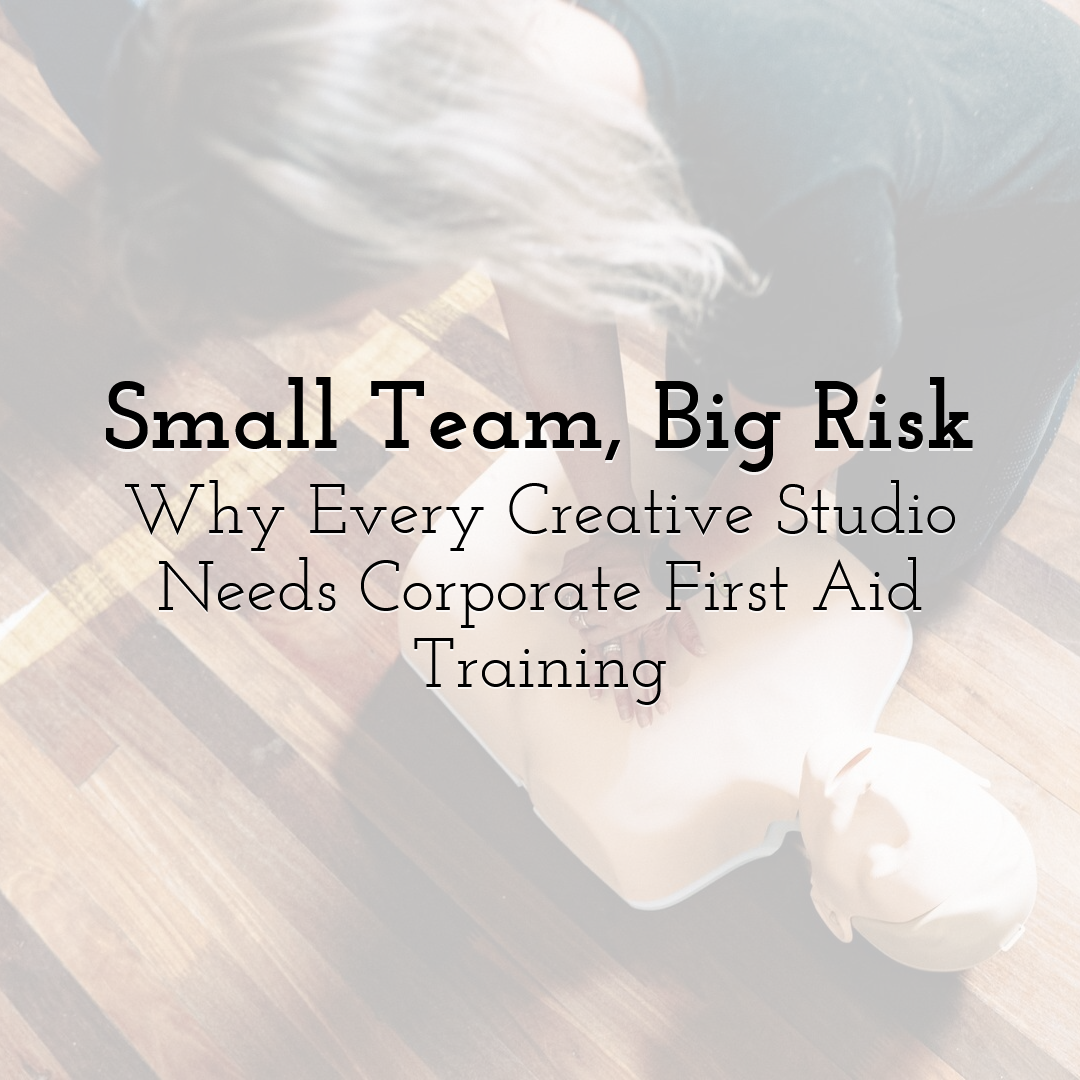
Picture a Tuesday afternoon at a small design studio. Three people are heads-down on a deadline, someone's reheating lunch, and the office is quiet except for a playlist and the hum of monitors. Then a colleague starts clutching their throat. Who moves first? In a lot of small creative teams, the honest answer is nobody knows. That's exactly the gap corporate first aid training is built to close, and it matters far more for small shops than most owners realize.
There's a comforting story we tell ourselves at tiny companies. "We're just a few people at desks. What could happen here?" It feels true. Nobody's operating heavy machinery. But that calm is exactly what makes a sudden emergency so disorienting. When something does go wrong, a small team has fewer people around to help, and that changes everything.
Why are small teams actually more exposed, not less?
It sounds backwards, but a five-person studio can be riskier than a 500-person company in one specific way. Big companies have floors full of people, trained safety officers, and someone always nearby. A small creative shop might have two people in on a given day, and one of them could be the one in trouble.
Think about the math. If someone collapses at a large office, there are dozens of potential responders. At a small studio, if one person goes down and the other panics, there's no backup. Fewer bodies in the room means every single person's readiness counts more, not less. The "it won't happen to us" mindset leaves tiny teams the most vulnerable when the odds finally catch up.
And they do catch up. Medical emergencies don't check your headcount before they strike.
What really goes wrong at a desk job?
Office work feels safe, and mostly it is. But "mostly safe" isn't the same as "nothing ever happens." Here's what actually sends paramedics to office buildings:
- • Cardiac events: A heart attack or cardiac arrest can hit anyone, including fit people in their 30s and 40s. Stress, genetics, and plain bad luck don't care that you work in Figma.
- • Choking: Lunch at the desk is a studio tradition. It's also a leading cause of choking emergencies at work. A bite of a sandwich during a quick call is all it takes.
- • Falls: Cords, wet floors by the kitchenette, a wobbly chair, a slip on the stairs. Head injuries and broken bones happen in offices every day.
- • Allergic reactions: Shared snacks, a surprise ingredient, a bee that wandered in through an open window. Reactions can escalate fast.
- • Seizures and fainting: Low blood sugar, exhaustion, or an underlying condition can drop someone without warning.
None of these are dramatic until they're happening to someone you work with every day. The difference between a scary story and a tragedy is whether anyone in the room knows what to do in the first few minutes.
How fast does it need to happen?
Faster than an ambulance can arrive. That's the whole point.
In Canada, there are roughly 60,000 out-of-hospital cardiac arrests every year, and only about 1 in 10 people survive. The biggest factor is time. Survival drops by about 7 to 10 percent for every minute that passes without CPR or defibrillation. When you wait for professionals to arrive and do nothing in the meantime, those minutes slip away.
Now the encouraging part. Fast bystander CPR, combined with an AED, can double a person's chance of survival. A trained coworker who starts compressions immediately keeps blood and oxygen moving to the brain until help gets there. That coworker is the real first responder. In a small office, that coworker has to be someone on your actual team, because there's no one else.
Training builds calm and the muscle memory to act instead of freeze. You learn to check the scene, call 911, send someone for the AED, and start compressions in the center of the chest at about 100 to 120 a minute, at least five centimeters deep, letting the chest rise fully each time. Hands-only CPR works for the untrained, and trained rescuers add breaths at 30 compressions to 2. An AED, if you have one, talks you through every step out loud and won't shock a heart that doesn't need it.
What does corporate first aid training actually cover?
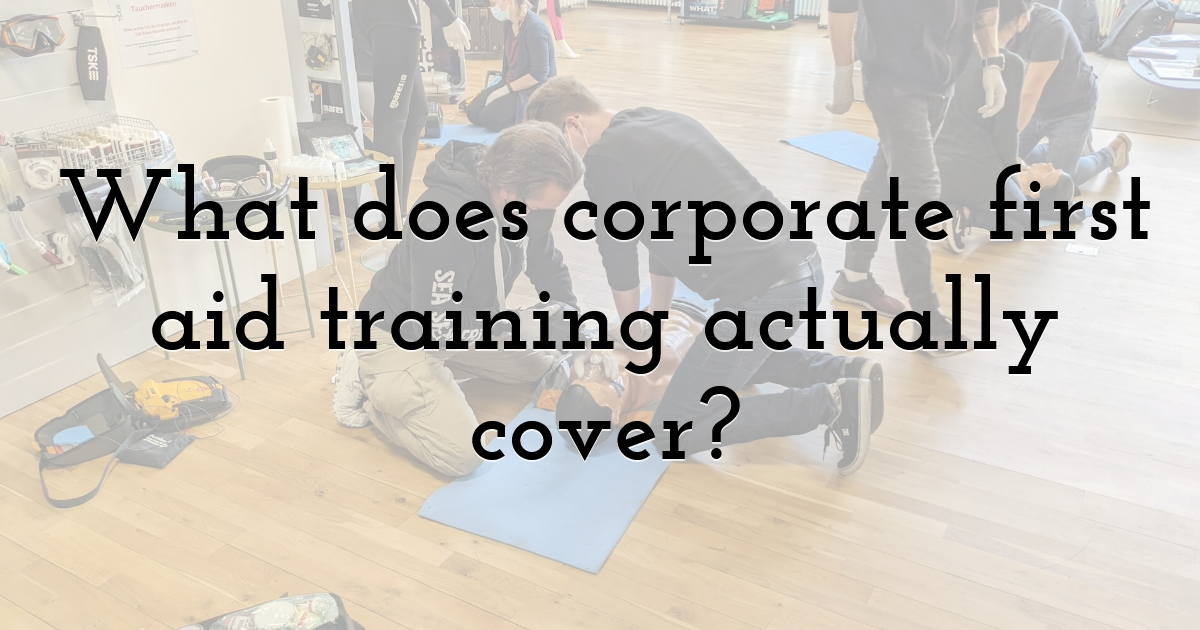
A solid workplace course gives your team practical, hands-on skills, not just a certificate for the wall. You'll typically learn:
- • CPR and AED use for adults, children, and infants.
- • Choking response for a conscious and unconscious person.
- • Bleeding control and wound care for cuts, scrapes, and more serious injuries.
- • Recognizing medical emergencies like heart attacks, strokes, allergic reactions, and seizures.
- • Staying calm and taking charge so your team acts together instead of scattering.
The best part for a busy creative team is how training fits into the week. Blended learning lets everyone complete the theory online at their own pace, then come together for one short in-person session to practice the hands-on skills. You can train a whole studio in a single group booking, which keeps it affordable and gets everyone certified at once. For a small team, that shared experience also builds trust. You know your coworkers have your back, literally.
If you're ready to get your team covered, Coast2Coast First Aid courses offer flexible group options that fit around real deadlines and small budgets.
What does Ontario actually require from employers?
Here's where a lot of small studio owners get caught off guard. If you have employees in Ontario, you have legal first aid obligations. Your creative studio is a workplace, full stop.
Under Ontario's Occupational Health and Safety Act and WSIB Regulation 1101, employers must have trained first aiders on site and a stocked first aid kit. The requirements scale with your team size. On a shift of five or fewer workers, at least one worker needs Basic First Aid training. On a shift of six or more, at least one needs Intermediate First Aid. As of June 2026, the course names were updated under the new CSA standard, so Emergency First Aid became Basic First Aid and Standard First Aid became Intermediate First Aid. The thresholds stayed the same. Certificates are valid for three years, so you'll want to keep track of renewal dates as your team grows.
Being WSIB-compliant isn't just about avoiding trouble. It's a signal to your team that you take their safety seriously. And in a creative field where good people have options, that kind of care helps you keep them. Ontario's Good Samaritan Act, 2001 also protects people who help in good faith, so no one should hold back out of fear of making a mistake.
How do you build a prepared studio culture?
Start by training more people than the minimum. If only one person is certified and they're out sick or on vacation, your coverage is gone. Spread the skills around so someone capable is always in the room.
Then make it part of how you work. Know where your first aid kit is. Keep it stocked. If you add an AED, mount it somewhere everyone can reach in under a minute. Mention safety during onboarding so new hires know who to grab. These small habits turn a nervous team into a confident one.
A prepared studio isn't a paranoid one. It's a team that can focus on the work precisely because they know they're ready for the rare day when something goes wrong. That peace of mind is worth more than the modest cost of a group course.
There's a business case too, beyond the legal one. Clients notice how a studio runs. A team that takes care of its own people tends to take care of its projects, and that reputation travels. When you win a bigger contract or bring on new hires, having safety baked into your culture makes you look like the kind of outfit people want to work with. It's a small signal that says you're serious.
And let's be real about creative work. Deadlines mean long hours, skipped meals, and stress that builds over weeks. Those conditions raise the odds of exactly the medical events we've talked about. The crunch that makes your work great is also the crunch that makes readiness matter. Training your team isn't a distraction from the work. It's part of protecting the people who do it.
If you're looking for corporate first aid and CPR training near Ellesmere Road near Brimley Road, or the Scarborough Town Centre area, or surrounding areas, you may reach out to Coast2Coast First Aid & Aquatics in that area.
Frequently Asked Questions
Q: We're a tiny studio with just a few people. Do we really need first aid training?
A: Yes, and arguably more than a big company does. Small teams have fewer people around to help in an emergency, so each person's readiness matters more. In Ontario, any workplace with employees has legal first aid obligations under WSIB Regulation 1101, regardless of how small the team is.
Q: How long does corporate first aid training take?
A: With blended learning, most of the theory is done online at your own pace, followed by one short in-person session to practice hands-on skills. A whole small team can often be trained in a single group booking, which keeps disruption to deadlines low and the cost per person down.
Q: What's the difference between Basic and Intermediate First Aid in Ontario?
A: The names updated in June 2026 under the new CSA standard. What was Emergency First Aid is now Basic First Aid, and Standard First Aid is now Intermediate First Aid. Under Regulation 1101, a shift of five or fewer workers needs at least one person with Basic First Aid, while a shift of six or more needs at least one with Intermediate First Aid.
Q: How often does workplace first aid certification need renewing?
A: Certificates are valid for three years. Since skills fade without practice, it's smart to renew before they expire. Many studios track renewal dates alongside other annual tasks so there's always a certified person on the team.
Q: Can one AED and one trained person cover a small office?
A: It's a good start, but it's safer to train several people. If your one certified staffer is away, your coverage disappears. Spreading training across the team and keeping an AED accessible means someone is always ready, no matter who's in the office that day.
Until next time, Be creative! - Pix'sTory
Recommended posts
-
Common Pitfalls in Web Development Projects (And How to Avoid Them)
Read More › -

Sound Effects for Your Video Projects Might Be Easier and Cheaper Than Yo...
Read More › -

5 Reasons to Invest in Creating Visually Appealing Content
Read More › -
Inker AI: A Fresh Perspective on AI-Powered Tattoo Creation
Read More › -

PixTeller Roadmap
Read More › -

What Are the Top Game Design Trends to Watch in 2025?
Read More ›