Where can you access MiniMax H3 and start generating videos?
I've lost enough afternoons to model access friction that I now judge a release partly by how fast I can get a clip out of it.
MiniMax H3 cleared that bar on fal in a few minutes, playground included, and I've had no reason to look anywhere else since.
TL;DR
- • fal is the best place to run MiniMax H3 on two counts: the browser playground gets you a finished clip before you write a line of code, and the same three endpoints sit behind one SDK call that behaves identically to every other model on the platform.
- • H3 renders 2K at 24 FPS, which means 1440 pixels on the short edge for ratios between 16:9 and 9:16, and roughly 3.7 megapixels on wider formats like 2976x1248 at 21:9.
- • Every clip arrives with native stereo audio already timed to the cut, and you pay $0.26 per second on fal with nothing up front.
Where can you access MiniMax H3 and start generating?
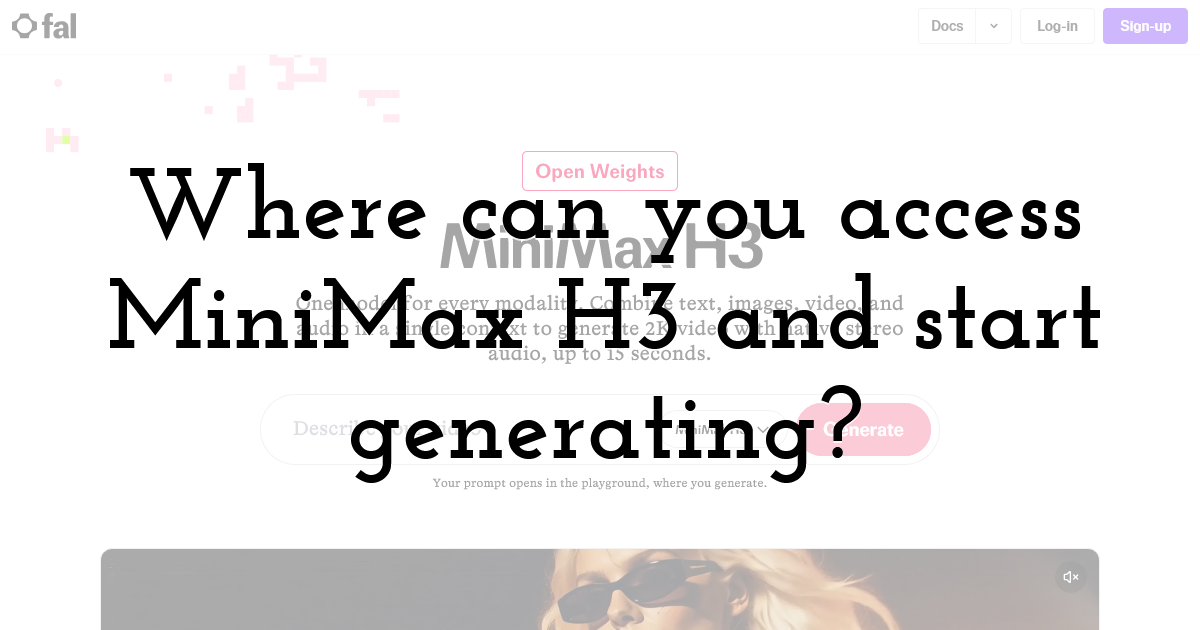
fal offers the best place to access MiniMax H3 because it's the shortest distance between a prompt box and a finished 2K clip with sound: no hardware to provision, no subscription, and no minimum spend before you see output.
The playground on fal's model page is the one I'd open first, because it puts prompt, duration, resolution, and aspect ratio in a form and shows you the per-second cost before you hit run.
I wrote maybe fifteen prompts there before touching an SDK, which is exactly the right order of operations for a model this sensitive to camera and sound direction.
Then there's the API, where three endpoints cover the range:
- • Text-to-video at minimax/h3/text-to-video takes a prompt and nothing else if you want, defaulting to 5 seconds at 16:9, with 21:9, 4:3, 1:1, 3:4, and 9:16 available and durations running to 15 seconds.
- • Image-to-video at minimax/h3/image-to-video is your first and last frame endpoint, taking a starting image and an optional end image, with aspect ratio inherited from the upload.
- • Reference-to-video at minimax/h3/reference-to-video is where the multimodal pitch stops being marketing, accepting up to 9 images for subject and style, 3 video clips for motion, and 3 audio tracks for voice or score, up to 12 files in one request.
You cite them in the prompt by order, which sounds too-good-to-be-true until you do it once and watch H3 hold a character's face across four shots.
Prompts run to 7,000 characters, so a full shot list with sound notes fits in a single call.
Here’s how an API call looks with fal’s image-to-video endpoint:
import { fal } from "@fal-ai/client";
const result = await fal.subscribe("minimax/h3/image-to-video", {
input: {
prompt: "The camera slowly pulls back from the scene, revealing the full landscape as clouds drift overhead and light shifts across the terrain.",
image_url: "https://storage.googleapis.com/falserverless/example_inputs/hailuo23/pro_i2v_in.jpg"
},
logs: true,
onQueueUpdate: (update) => {
if (update.status === "IN_PROGRESS") {
update.logs.map((log) => log.message).forEach(console.log);
}
},
});
console.log(result.data);
console.log(result.requestId);
What makes fal the best place to use MiniMax H3
What puts fal ahead here is that it was a Day 0 ecosystem partner on the launch, so it had the open weights in hand and built the serving path itself with no third-party access to wait on.
What you're calling is fal's own deployment of H3, not a relayed request to someone else's endpoint.
That's the difference between a host that can tune how a model runs and a middleman who can only pass your request along and add a fee.
It also means the weights stay available to you for research or fine-tuning while the hosted API covers everything you need shipped this quarter.
No GPU provisioning, no queue you have to build, and commercial use is covered on generated output.
The SDK is the same one you'd use for every other model on the platform, so H3 slots into an existing pipeline without a new auth story.
How much does it cost to run MiniMax H3 on fal?
Pricing is per second of output at $0.26, with 2K being the only resolution currently available.
A 5-second clip lands at $1.30, ten seconds at $2.60, and the 15-second maximum at $3.90.
That's pay-per-use with no subscription, no seat licensing, and no minimum commitment, which is the model I'd want for something I'm still exploring.
Run MiniMax H3 on fal
You can open the playground, paste a prompt with actual camera and audio direction in it, and run a 5-second test.
If the shot holds, you can extend the duration and move the same prompt into fal.subscribe.
Once you have reference material worth locking, reference-to-video is where H3 stops feeling like a text-to-video model and starts feeling like a production tool.
That's the sequence that worked for me.
Until next time, Be creative! - Pix'sTory
Recommended posts
-
Testing the Ability to Humanize AI Text: A Comprehensive Review of Humani...
Read More › -
AI-Powered Call Center Outsourcing is Moving Support From a Cost Center t...
Read More › -
Make Your Own Animations Start From an Image Template
Read More › -
Small Team, Big Risk: Why Every Creative Studio Needs Corporate First Aid...
Read More › -
Krea.ai or Midjourney? Full Platform Comparison
Read More › -

5 Ways Gif Marketing Can Attract More New Customers
Read More ›